
Machined Bicycle Components: Where Precision Matters Most

Why do machined bicycle components get so much attention?
In advanced cycling, small tolerances create very visible results on the road, trail, or test bench.
That is why machined bicycle components matter far beyond aesthetics or premium branding.
They influence how power moves through the drivetrain, how accurately parts align, and how long critical interfaces stay stable under load.
At ACMD, this topic sits naturally beside carbon fiber frames, electronic derailleurs, and lightweight mobility systems.
The reason is simple.
Precision machining is one of the places where material science, performance engineering, and real riding efficiency meet.
In practical terms, machined bicycle components often decide whether a high-spec bike feels crisp, vague, quiet, or wasteful.
For anyone studying two-wheel innovation, they are a useful lens for understanding where measurable gains still come from.
So what counts as a machined bicycle component?
The term usually refers to parts shaped by CNC milling, turning, boring, drilling, or finishing processes.
These methods remove material with high repeatability.
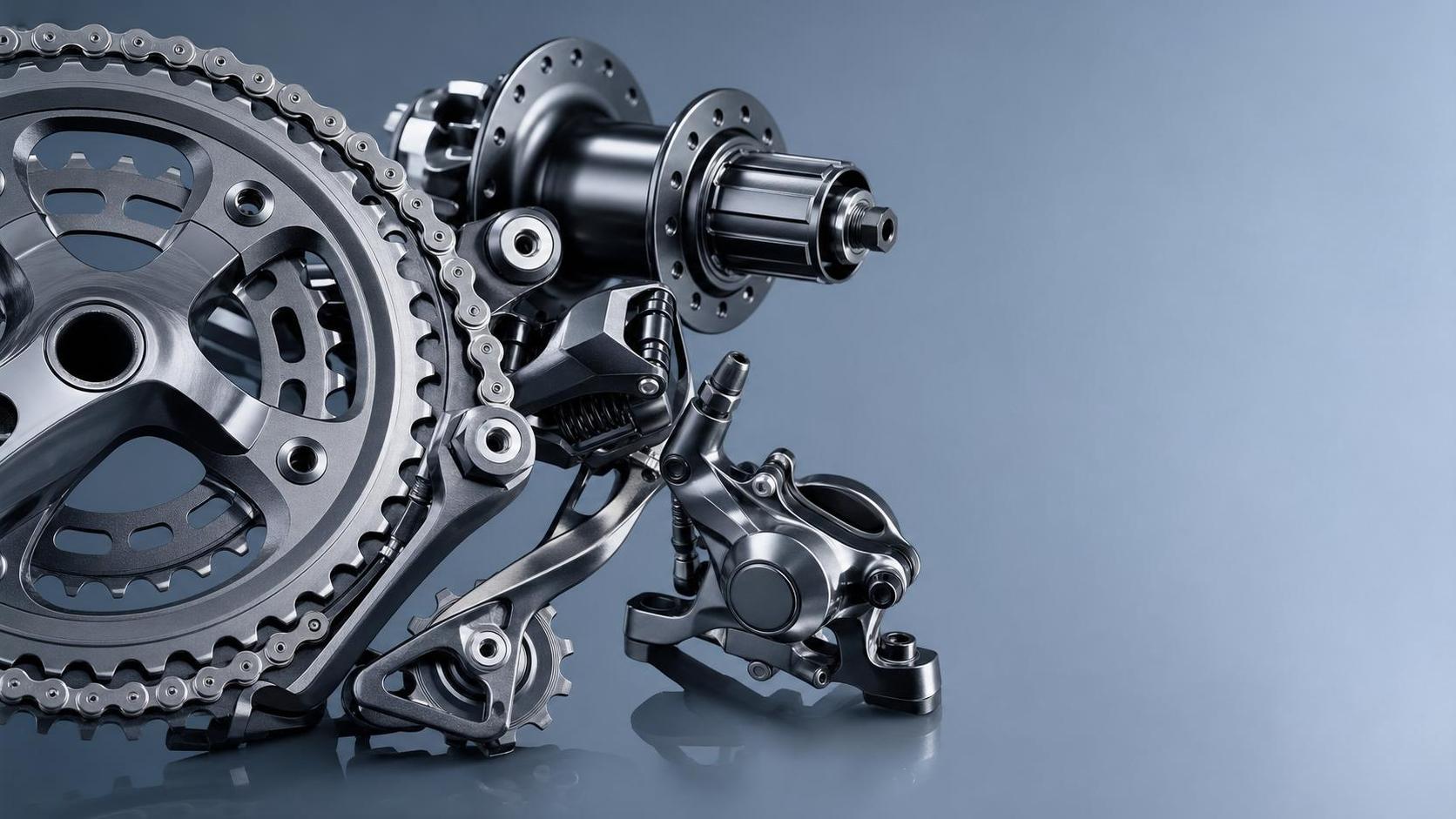
Common examples include chainrings, derailleur cages, brake caliper bodies, hubs, pedal spindles, suspension hardware, and cockpit clamps.
Not every bicycle part needs the same machining depth.
A decorative cover and a load-bearing interface have very different precision demands.
That is where confusion often starts.
People may assume machined bicycle components are always lighter or always stronger.
More often, the real value is dimensional control.
A part can be beautifully machined and still perform poorly if the design logic is weak.
Likewise, a forged or molded part may outperform a machined one in the wrong application.
The better question is not whether machining was used.
It is where machining improves fit, load path, stiffness, heat behavior, or serviceability.
Where does precision matter most on a bicycle?
The highest-value areas are usually the ones connecting motion, force, or alignment.
In those zones, tiny errors spread into noise, drag, wear, or handling instability.
This is especially relevant in elite drivetrains.
As electronic shifting gets faster, hardware accuracy becomes even less forgiving.
Millisecond control cannot compensate for a poorly machined interface forever.
The same logic appears in e-bikes and high-speed micro-mobility platforms.
Higher torque loads place more stress on chain engagement, motor mounts, axles, and brake systems.
Precision, then, is not only a racing topic.
It is increasingly a reliability topic across the wider mobility market.
Are machined bicycle components mainly for race bikes?
Not anymore.
Racing still pushes the most visible use cases, especially where stiffness-to-weight ratios matter.
But the benefits now extend across several categories.
- Road performance bikes need crisp shifting and low rotational losses.
- Mountain bikes need durable interfaces that survive mud, shock, and repeated impacts.
- Gravel bikes benefit from chain security and long-distance service consistency.
- E-bikes place heavier torque cycles on chainrings, mounts, axles, and braking systems.
- Urban mobility fleets value predictable maintenance intervals and interchangeability.
In other words, machined bicycle components serve different priorities in different machines.
For a race bike, the gain may be speed and response.
For a shared mobility system, the gain may be service predictability.
For a premium e-bike, it may be quiet operation under higher motor assistance.
That broader relevance explains why ACMD tracks machining quality alongside drivetrain architecture and lightweight materials.
How can you tell whether a part is precisely made or just marketed that way?
A polished finish is not enough.
The more useful signs are functional, repeatable, and often visible in use.
Start by looking at the interface the part must control.
If it touches a bearing, a chain, a rotor, a clamp surface, or a carbon structure, tolerances matter more.
Then check whether the design supports the material and process.
Over-machining can remove useful material and create stress risers.
That issue appears in some ultra-light parts that look impressive but age badly.
A grounded evaluation usually includes these questions:
- Does the part hold alignment after repeated load cycles?
- Are wear surfaces uniform and easy to inspect?
- Is the material suitable for the torque and fatigue pattern?
- Can the part be serviced without damaging adjacent lightweight structures?
- Is there evidence of testing, tolerance control, or quality traceability?
In research terms, the best machined bicycle components show value through consistency, not just headline weight savings.
That consistency is often what separates engineering quality from cosmetic machining.
What mistakes are most common when comparing machined bicycle components?
One common mistake is treating machining as a standalone performance guarantee.
It is only one part of the system.
A derailleur cage, for example, depends on pulley quality, spring behavior, chain condition, and hanger alignment.
Another mistake is chasing the lightest part without checking fatigue life.
This matters more when the bike combines high torque, rough terrain, or long maintenance intervals.
A third mistake is ignoring compatibility with adjacent materials.
Machined aluminum clamping a thin carbon tube needs careful surface design and torque control.
To keep comparisons practical, use a short decision frame.
This approach keeps the conversation tied to function, not showroom language.
What should be checked before choosing or studying these parts further?
Begin with the riding load case.
A lightweight road build, a downhill bike, and a cargo e-bike stress components very differently.
Next, map the system around the part.
Machined bicycle components rarely act alone.
They interact with frame materials, electronic controls, bearings, braking heat, and maintenance habits.
It also helps to separate three goals that are often mixed together:
- Precision for efficiency, such as cleaner shifts and lower friction.
- Precision for durability, such as stable interfaces and slower wear.
- Precision for integration, such as better fit with carbon frames or electronic systems.
That distinction is useful when following market signals.
ACMD’s coverage of micro-mobility, drivetrain evolution, and lightweight structures shows that performance is becoming more interconnected.
As vehicles get lighter, smarter, and more electrified, machining quality becomes easier to notice and harder to fake.
The clearest next step is to compare parts by interface function, load severity, and service expectations.
That method gives a more reliable view than weight claims or finish quality alone.
In the end, machined bicycle components matter most where precision directly shapes energy transfer, control, and long-term stability.
If further evaluation is needed, build a simple checklist around tolerance-critical areas, material pairing, fatigue exposure, maintenance interval, and real operating conditions.
Related News