
EU Tightens E-Bike Battery Certification Rules

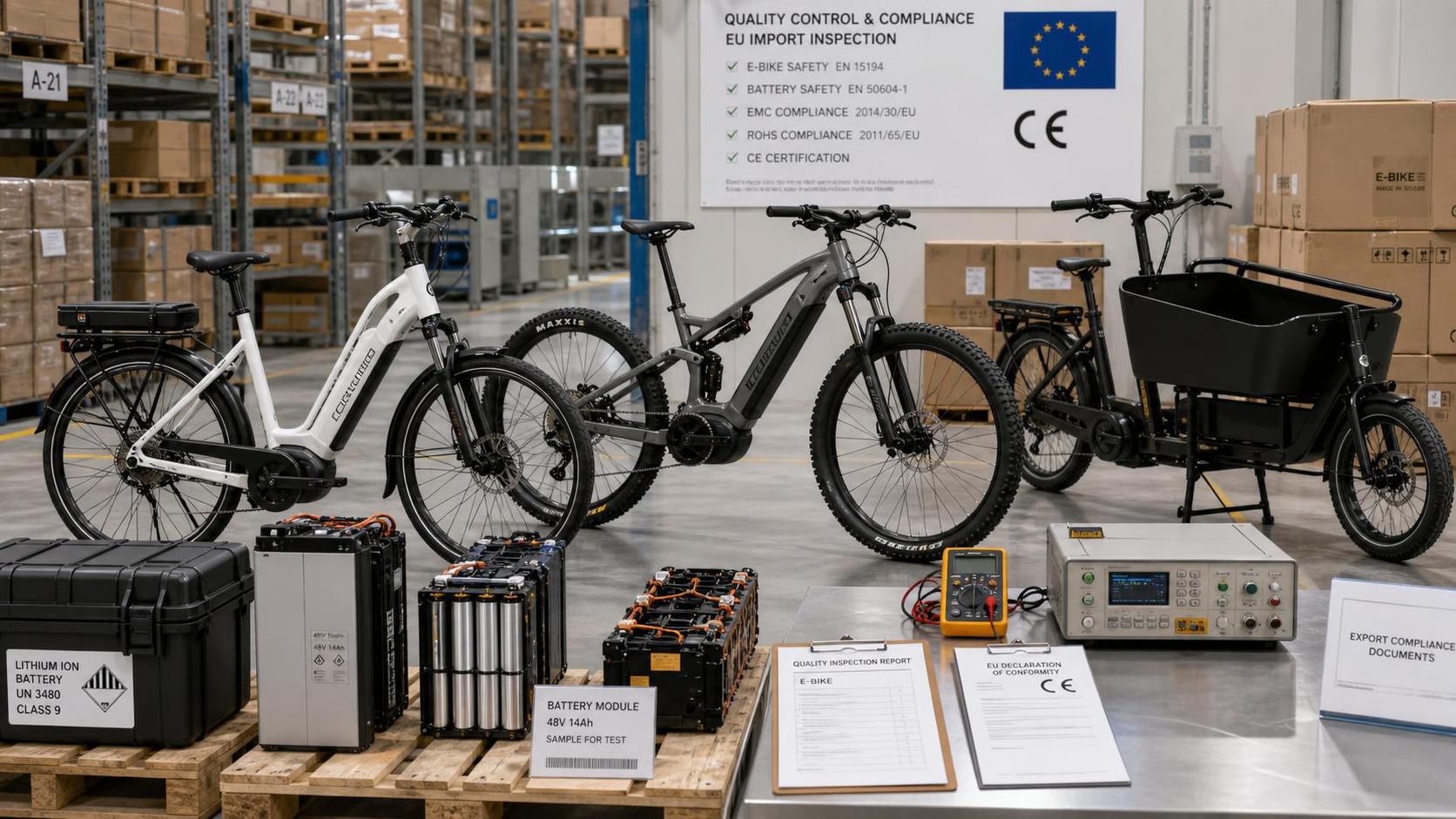
From 4 August 2026, the EU market will require lithium-ion batteries used in imported City Commuter E-bikes, e-MTBs, and Cargo E-bikes to meet both UN38.3 transport safety testing and EN62133-2:2025 cell safety requirements. For exporters, battery module suppliers, OEM and ODM manufacturers, and the parties preparing CE-related documentation, this is not just a technical update: it changes the compliance path tied to customs clearance, certification review, and delivery readiness for products entering the EU.
What the new requirement now covers
According to the provided event summary, the requirement takes effect on 4 August 2026 and applies to lithium-ion batteries installed in imported City Commuter E-bikes, e-MTBs, and Cargo E-bikes sold into the EU market. The batteries must pass both UN38.3 and EN62133-2:2025. The EN62133-2:2025 requirement includes an added verification item related to thermal runaway propagation blocking.
The same summary states that batteries without both certifications will be detained by customs and barred from clearance. It also states that the requirement has been added to the CE notified body review checklist and applies to complete vehicles and battery modules submitted under a Declaration of Conformity through an EU authorized representative.
Where the pressure will show up in the export chain
Battery compliance is becoming a shipment gate
From an industry perspective, battery suppliers and pack integrators are likely to face the earliest direct impact because the rule is tied to both transport testing and cell safety certification. The immediate business issue is whether existing battery configurations, supporting reports, and technical files are aligned with the dual-certification requirement before products are presented for export and customs clearance.
For companies shipping into the EU, the change affects not only product qualification but also shipment readiness. What deserves closer attention is whether battery-related documentation can support the declared compliance path for the exact modules installed in the exported vehicles.
OEM and ODM exporters may need to recheck their approval path
Analysis shows that Chinese OEM and ODM manufacturers are directly exposed because the provided summary explicitly notes that the rule affects their export compliance route. In practice, this means the battery can no longer be treated as a secondary supporting component within the broader vehicle file. It now sits closer to the center of market access review, especially where the Declaration of Conformity is submitted through an EU authorized representative.
The pressure points are likely to appear in model approval preparation, battery configuration management, document consistency, and export scheduling. Where a vehicle program relies on multiple battery options, the compliance status of each option becomes a practical issue for order confirmation and dispatch planning.
Certification and testing functions will face stricter file alignment
Certification-related companies and testing service providers may also see a more exacting review environment because the requirement has been incorporated into the CE notified body checklist. Observably, this raises the importance of consistency between test reports, technical documentation, battery module specifications, and the final conformity submission.
Even without additional execution details in the input, companies involved in compliance support should expect closer scrutiny of how battery evidence is presented and matched to the exported product scope.
Buyers and channel operators may focus more on documentary certainty
For procurement teams, distributors, and import-side commercial operators, the practical issue is not only product performance but whether the battery installed in a given model can support uninterrupted entry into the EU market. Analysis shows that purchasing decisions may increasingly depend on whether suppliers can present complete dual-certification evidence in a form that fits customs, certification, and delivery requirements.
This matters most where delivery timing, model-specific battery selection, and after-sales replacement planning depend on the same battery compliance status.
What companies should review now
Check whether battery files match the new dual-certification threshold
Analysis shows that the first priority is to verify whether the lithium-ion batteries used in affected e-bike categories are supported by both UN38.3 and EN62133-2:2025 documentation. Because the summary specifically references thermal runaway propagation blocking under the updated standard, companies should pay close attention to whether existing technical files and reports correspond to that requirement rather than assuming older documentation remains sufficient.
Reconcile product declarations with battery module scope
What deserves closer attention is the relationship between the battery module actually installed in the product and the conformity documentation submitted through the EU authorized representative. Where multiple trims, battery variants, or pack substitutions exist, companies should review whether the declared scope and the tested scope remain aligned.
Prepare for customs and certification review as linked steps
Observably, the input points to customs detention risk and notified body checklist integration at the same time. Companies should therefore treat shipping documentation, certification evidence, and technical submission materials as connected compliance elements rather than separate administrative tasks. This is especially relevant for export scheduling and handover planning.
Watch for follow-on changes in execution language and buyer requirements
The provided information does not include detailed enforcement guidance, sample documentation formats, or buyer-side implementation rules. For that reason, it is more appropriate to monitor how execution language, tender documents, customer specifications, and review practices develop, rather than assume a fully settled operating pattern from day one.
Why this looks like an enforcement signal, not just a standards update
Analysis shows that this development is better understood as a market-entry control signal rather than a purely technical revision. The combination of a transport safety test, an updated cell safety standard, customs detention consequences, and inclusion in a CE notified body checklist indicates that battery compliance is being linked more tightly to actual access to the EU market.
At the same time, it would be premature to infer broader outcomes beyond the provided facts. The input confirms the rule change and its immediate compliance consequences, but further observation is still needed on detailed review practices, documentation expectations, and how consistently the requirement is applied across affected product flows.
How this update is best understood at this stage
From an industry perspective, the 4 August 2026 change is best read as a landed compliance requirement with direct effects on export preparation, customs clearance, and CE-related review for affected e-bike categories. The practical takeaway is not simply that standards have been updated, but that battery certification status now has a more visible role in whether products can move through the EU entry process without interruption.
It is more appropriate to understand this as an implemented compliance threshold accompanied by ongoing execution questions. Companies involved in battery supply, vehicle assembly, export filing, and certification support should focus on documentation alignment and delivery risk while continuing to track how the rule is applied in practice.
Basis of this article and what still needs verification
This article is based on the user-provided news title, event date, and event summary. For developments of this kind, relevant source types typically include official announcements, regulator releases, customs or trade authority notices, industry association updates, standards organization documents, and reporting by established trade media. No specific official source link was provided in the input, so the underlying official link and any later interpretive materials still need to be verified on an ongoing basis.
Further observation should focus on detailed implementation language, certification review practice, changes in tender or procurement documents, market feedback, and how affected companies execute the requirement in actual export and delivery workflows.