
Thermoset Composite Materials: Key Limits in Structural Design

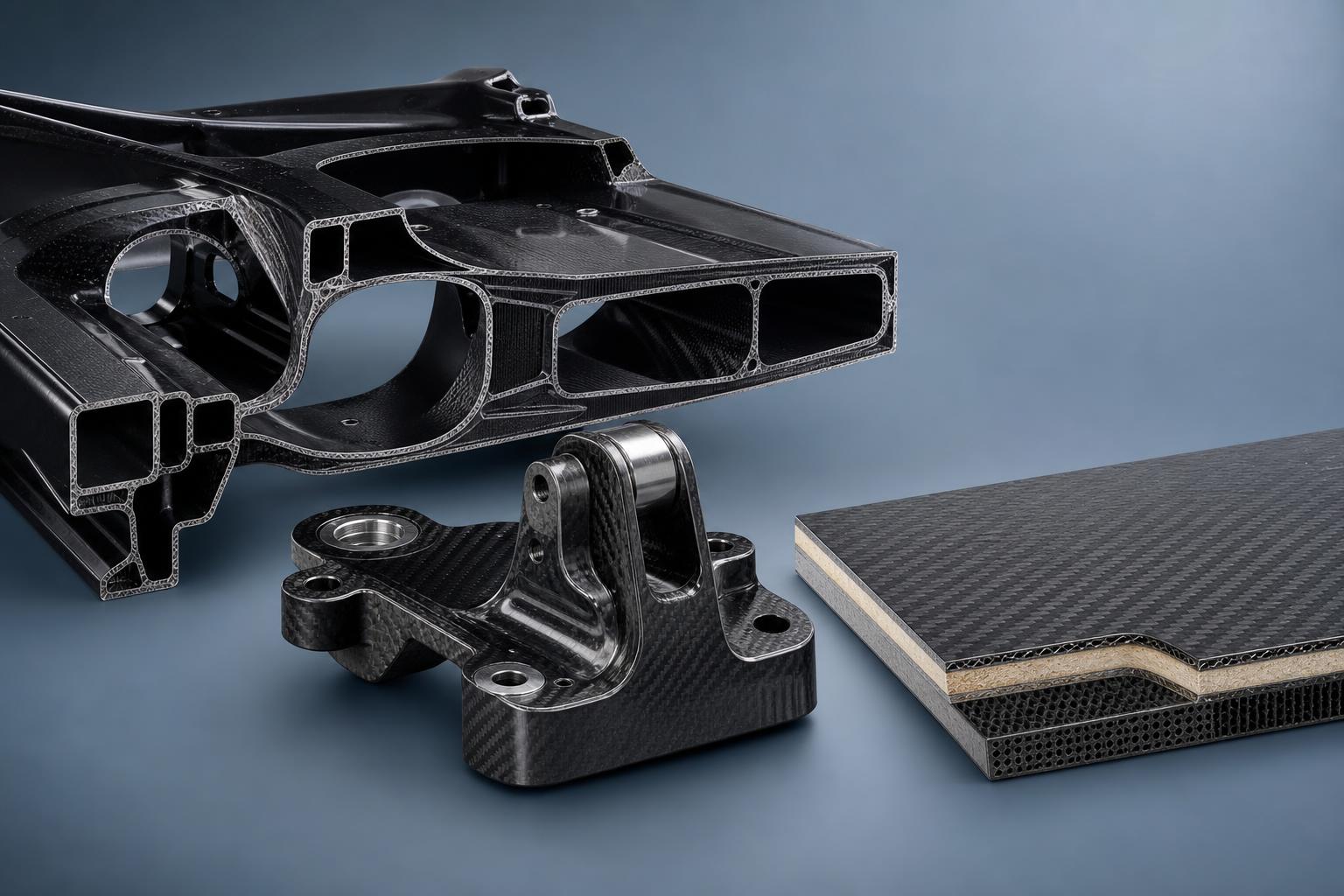
Thermoset composite materials sit at the center of lightweight structural design, especially where stiffness, fatigue control, and geometry freedom matter more than easy rework. In advanced mobility, from carbon fiber frames to compact transmission supports, their advantages are clear. Their limits are less obvious. That gap matters, because structural evaluations often fail not on headline strength, but on heat exposure, impact response, bond integrity, and production variability.
Why design limits deserve closer attention
A thermoset matrix does not simply hold fibers together. It defines damage tolerance, environmental stability, load transfer, and long-term reliability. When that matrix reaches its practical limit, the laminate may still look intact while its structural margin is already shrinking.
This is especially relevant in sectors tracked by ACMD. E-bikes, e-scooters, high-speed e-motorcycles, derailleur systems, and carbon frame platforms all push for lower mass and higher performance. That pressure encourages ambitious layups, thinner walls, tighter packaging, and mixed-material assemblies.
In such conditions, thermoset composite materials are rarely judged only by coupon data. They are judged by how consistently they survive vibration, weather, crash events, adhesive interfaces, and manufacturing deviations across real production volumes.
What thermoset composite materials really offer
Most structural thermoset composite materials combine reinforcing fibers with a cured polymer matrix, commonly epoxy, vinyl ester, or polyester. Once cured, the matrix forms a cross-linked network. Unlike thermoplastics, it cannot be melted and reshaped.
That irreversible cure is a benefit and a constraint. It supports dimensional stability, chemical resistance, and high stiffness retention. At the same time, it limits repair flexibility, recycling pathways, and tolerance to certain thermal cycles.
For structural design, the attraction is straightforward:
- high specific stiffness for lightweight frames and housings
- tailored layup direction for local load paths
- good fatigue behavior when loads stay within design assumptions
- surface quality and shape freedom for aerodynamic structures
The complication is that these strengths depend heavily on fiber orientation, resin quality, cure control, and joining strategy. In other words, material selection alone does not define performance. Structural context does.
The main limits that shape real-world performance
Brittleness and impact sensitivity
Thermoset composite materials can carry high loads efficiently, but they are often less forgiving under sharp impact than metals. A dropped tool, curb strike, or crash may create internal delamination without dramatic surface cracking.
That matters in mobility products exposed to transport handling, road debris, and repeated minor hits. Hidden damage can reduce compressive strength far more than visual inspection suggests.
Out-of-plane weakness
Designers often focus on in-plane tensile values because they look impressive. Yet many failures begin through interlaminar shear, peel stress, or through-thickness cracking. Holes, inserts, bonded joints, and clamp zones are common triggers.
This is one reason why lightweight carbon assemblies for bicycle frames or precision drivetrain carriers require close attention near fasteners and interface hardware.
Temperature ceilings and glass transition
A cured thermoset does not melt, but it still softens as temperature approaches its glass transition range. Stiffness, matrix-dominated strength, and bond performance may decline before obvious deformation appears.
In compact electric mobility platforms, thermal exposure may come from motors, batteries, braking systems, dark surface heating, or post-cure variation. A part that passes static testing at room temperature may lose margin in summer service.
Moisture, chemicals, and aging
Thermoset composite materials generally resist corrosion better than metals, but they are not immune to environmental change. Moisture absorption can alter matrix properties, reduce glass transition temperature, and weaken some adhesive interfaces.
Cleaning agents, road salts, UV exposure, and cyclic humidity should be treated as structural variables, not cosmetic ones.
Process dependence
Few materials are as sensitive to manufacturing detail as thermoset composite materials. Fiber waviness, void content, resin-rich corners, cure gradients, and trimming damage all influence final behavior.
For technical evaluation, this means laboratory values should never be accepted without asking how closely they match the intended process route.
Where these limits show up across mobility systems
ACMD’s coverage areas provide a useful lens because they combine lightweight ambition with real-world punishment. The table below shows how design limits surface in practice.
The pattern is consistent. The more integrated and compact the design becomes, the more valuable thermoset composite materials are, and the more carefully their limits must be validated.
How to evaluate without overestimating performance
A strong assessment starts by separating fiber-dominated claims from matrix-dominated risks. Tensile modulus along the fiber direction tells only part of the story. Service failure often starts elsewhere.
Look beyond nominal strength
- Check compressive after impact performance, not only pristine laminate strength.
- Review interlaminar shear, hole-bearing, and bonded-joint data.
- Ask for hot-wet properties, not dry room-temperature values alone.
- Compare coupon data with subcomponent or assembly validation.
Match the material to the process
Prepreg autoclave laminates, compression-molded SMC parts, and resin transfer molded structures should not be treated as equivalent simply because they share a thermoset base. Their void levels, fiber volume fractions, and defect sensitivities differ meaningfully.
That distinction is important for businesses balancing performance with production scale, cost, and consistency.
Treat joints as a primary design domain
In many assemblies, the laminate is not the weakest point. The transition between composite and metal is. Inserts, bonded shells, threaded interfaces, and clamped regions should be assessed early, because local stress concentrations can erase the theoretical advantage of the laminate.
Business value in getting the limits right
Accurate understanding of thermoset composite materials supports more than material selection. It reduces redesign cycles, test repetition, warranty exposure, and certification surprises.
For intelligence-led platforms like ACMD, this is where technical and market insight meet. A carbon frame may win attention through weight and stiffness claims, but long-term brand value depends on damage tolerance, quality repeatability, and credible structural validation.
The same logic extends to electric mobility platforms. Lightweight structures help range, handling, and packaging. Yet if heat, vibration, or crash loads are misread, the commercial cost returns later through recalls, restrictive safety margins, or inflated manufacturing controls.
A practical next step for structural review
When reviewing thermoset composite materials, begin with the actual load environment, not the material brochure. Map where the structure sees impact, elevated temperature, moisture, fastening pressure, and inspection difficulty.
Then compare three layers of evidence: laminate data, joint data, and process capability. If one layer is weak, the design margin is less certain than the headline numbers imply.
That approach usually leads to better decisions than chasing the lightest possible layup. It clarifies where thermoset composite materials truly create value, where their limits are manageable, and where an alternate architecture deserves consideration.
For any next evaluation cycle, it is worth building a checklist around temperature margin, impact tolerance, interface design, and manufacturing consistency. Those four lenses reveal most of the hidden risk before validation costs escalate.
Related News