
What Should You Check Before Sourcing E-Bike Battery Suppliers?

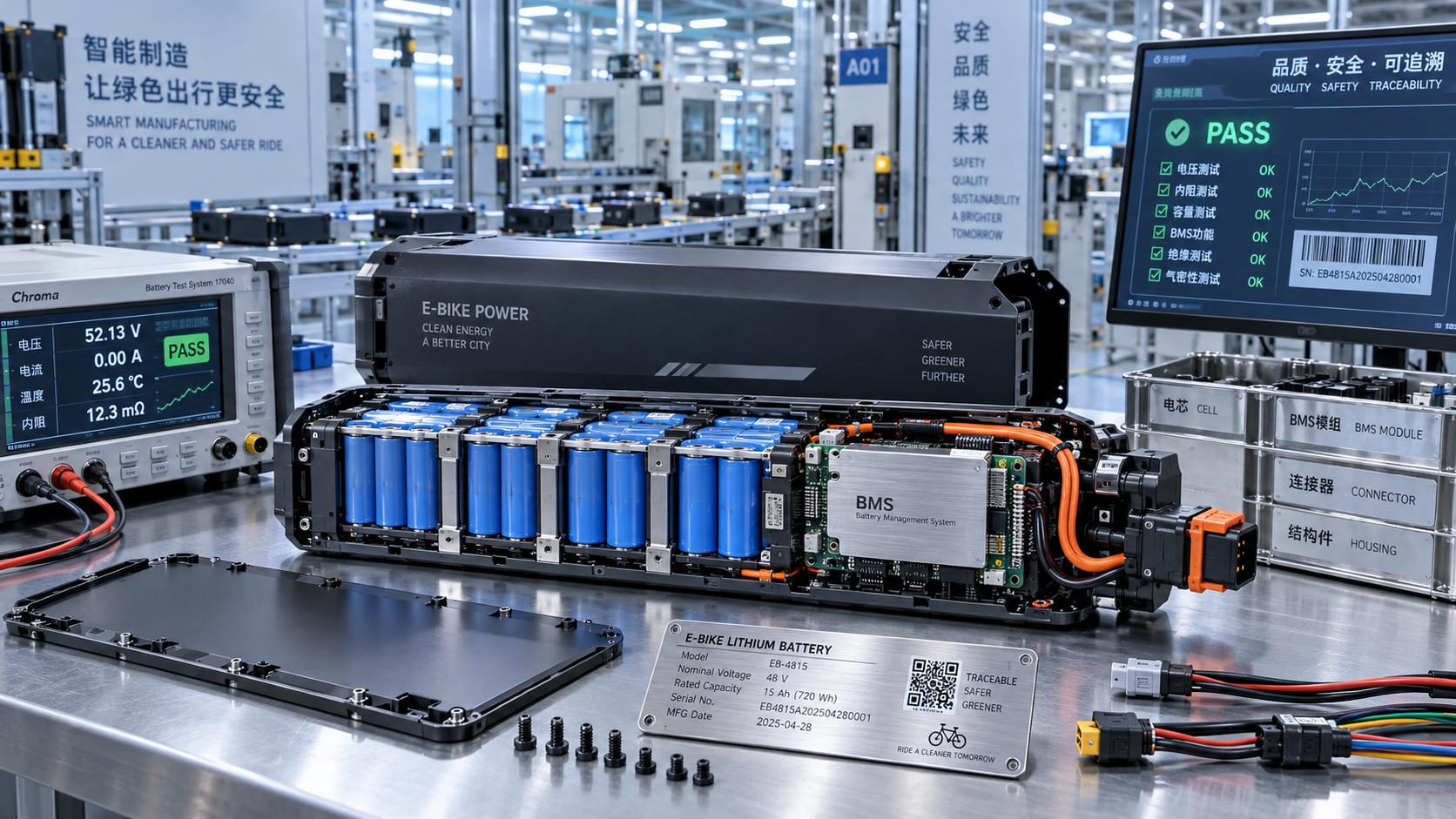
The question is not simply whether a battery supplier can provide the voltage, capacity, and enclosure size shown on a specification sheet. Before sourcing an e-bike battery supplier, check whether the supplier can repeatedly deliver a battery system that is safe, electrically compatible, traceable, serviceable, and stable across the full life of the bike.
A low quotation can hide weak cells, limited quality control, unclear battery-management logic, or a supply chain that changes without notice. Those risks usually appear after the e-bike reaches the road: inconsistent range, sudden shutdowns, charging faults, overheating complaints, difficult warranty claims, and delayed production. A better sourcing decision comes from comparing suppliers on the parts of the battery system that affect real use, not only its headline capacity.
Start with the battery system, not just the pack rating
Two battery packs can both be described as 48 V and have similar claimed watt-hour figures, yet behave very differently. The difference may come from the cell model, cell matching, pack layout, weld quality, protection settings, cooling path, sealing design, charger compatibility, and firmware in the battery management system (BMS).
Before asking for prices, define the duty cycle of the e-bike. A lightweight commuter, a cargo bike, a rental fleet bike, and an off-road performance model place different demands on a battery. High current draw, repeated hill climbing, frequent fast charging, cold-weather use, rough roads, and long daily operating hours all change what a suitable battery looks like.
A supplier that is appropriate for a low-power urban bike may not be a good fit for a bike that demands sustained high output. Conversely, a highly specified pack can add unnecessary cost and weight to a simple commuting model. The first comparison should therefore be between your operating conditions and the supplier’s demonstrated pack design, rather than between two capacity labels.
Compare cell quality and cell sourcing discipline
The cells are the core energy-storage component, but “branded cells” alone is not a complete answer. Ask what cell format and chemistry the proposed pack uses, whether the cell source is consistent, and how the supplier prevents substitution when availability becomes tight. A reliable supplier should be able to identify the intended cell model and explain why it suits the required discharge rate, cycle pattern, space constraints, and charging profile.
Cell matching matters as much as the cell name. A pack assembled from cells with uneven electrical characteristics can lose balance over time. That can reduce usable capacity, trigger protective cutoffs early, and place more stress on weaker cell groups. The supplier should have a defined incoming inspection and sorting process, rather than treating all delivered cells as interchangeable.
Be cautious when a quotation lists a familiar cell brand but provides no clear link between the quotation, sample, and production bill of materials. The practical question is: can the supplier show that the same approved cell configuration will be used in the units delivered later? A controlled change process is more valuable than a broad promise that “equivalent” components will be used.
The BMS determines how the pack behaves under stress
The BMS is often treated as an invisible accessory. In practice, it is a central safety and performance component. It monitors cell groups and controls protection functions such as overcharge, over-discharge, overcurrent, short-circuit, and temperature response. Its configuration affects whether a rider experiences steady assistance, a gradual reduction in power, or an abrupt cutoff when demand rises.
Ask the supplier how the BMS is matched to the motor controller, charger, and intended current draw. A battery that disconnects too easily can create poor ride quality. A battery configured with overly permissive thresholds can expose cells and connections to damaging conditions. The goal is not to select the most aggressive setting; it is to create a protection strategy that suits the complete electrical system.
Temperature sensing deserves specific attention. Sensors need to be placed where they can detect meaningful thermal conditions, and the BMS must respond in a way that protects the pack without making the product unusable in normal conditions. A supplier should be able to explain what happens during charging and discharging outside the intended temperature range.
Also establish how firmware is managed. If the BMS can be configured or updated, determine who controls the settings, whether different production batches can be identified, and how service teams will diagnose a battery fault. A technically capable BMS is less useful if no one can determine why it has entered protection mode.
Safety documentation should connect to the exact battery you are buying
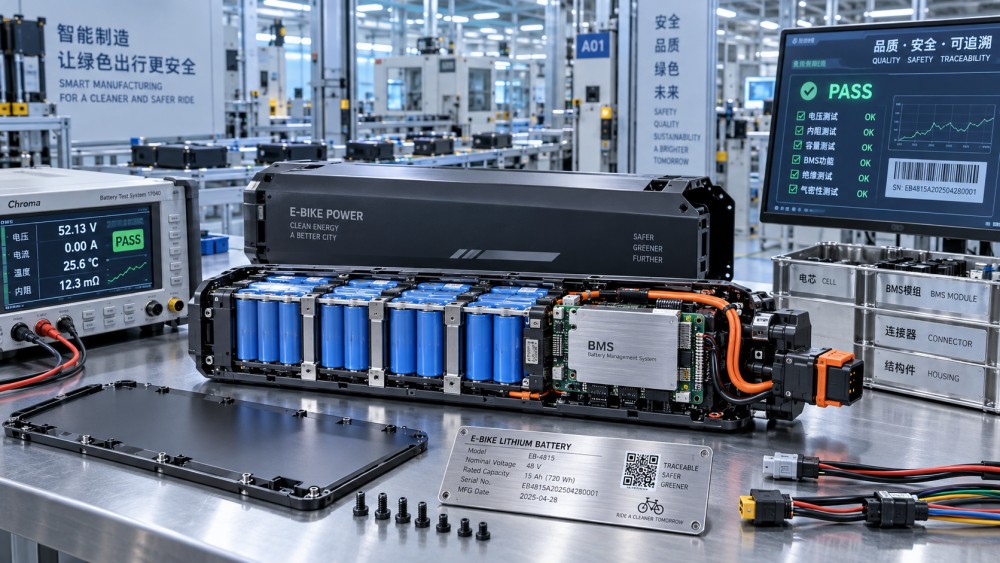
Safety and transport documentation are not paperwork to collect at the end of sourcing. They are part of the product definition. Request documentation that relates to the actual battery configuration: its cells, pack architecture, electronics, enclosure, and charging arrangement. A report for a similar-looking pack is not automatically evidence for the version installed on your e-bike.
The level of documentation needed depends on the markets where the bike will be sold and shipped, as well as on the role of the battery in the finished product. What matters during supplier comparison is whether the supplier understands this link and maintains the technical records needed to support it.
Look for disciplined answers to practical questions: Which pack version does each document cover? What happens if the enclosure, cell, BMS, or charger changes? Can serial numbers connect a delivered unit to a production lot and its inspection records? Can the supplier provide information needed for transport, service, and end-of-life handling?
A supplier that only sends a folder of generic certificates may still make an acceptable pack, but it creates avoidable uncertainty. Stronger partners treat documentation as a controlled part of engineering and production.
Check thermal design in the context of the bike
Heat is not produced by the cells alone. Resistance in nickel strips, connectors, wiring, fuses, terminals, and controller interfaces can also contribute to temperature rise. Battery placement then determines whether that heat can dissipate or accumulates inside a constrained frame cavity, rear rack case, or sealed housing.
This is why a pack should be evaluated with the proposed e-bike system in mind. A removable downtube battery may face rain exposure, vibration, and frequent insertion cycles. An integrated pack may have less airflow and be harder to inspect or replace. A rack battery may have more space but can be exposed to impact and altered weight distribution. Each layout needs different attention to sealing, locking, cable routing, connector protection, and heat management.
Ask for information on how the supplier evaluates high-load discharge, charging behavior, vibration resistance, and abuse risks relevant to the intended design. You do not need a dramatic claim that the battery is suitable for every condition. You need evidence that the pack was designed for conditions similar to the ones it will actually face.
Traceability is what makes a warranty problem manageable
A battery failure becomes expensive when it cannot be isolated. Without traceability, a single complaint may lead to uncertainty about every pack in a shipment. With traceability, it is more practical to identify the affected production period, component batch, assembly line, inspection result, and software version.
At a minimum, examine how the supplier assigns serial numbers and whether those numbers remain durable and readable after installation. Then ask what records are associated with each number. Useful records can include cell batch information, BMS version, final inspection data, production date, and shipment lot.
Traceability also supports service. If a charger fault, connector issue, or BMS event occurs, technicians need a way to distinguish a battery problem from a motor-controller problem or an installation error. A supplier that can provide fault interpretation, service instructions, and a defined return-analysis process will reduce uncertainty after launch.
Do not approve a sample without defining production controls
Sample approval is necessary, but it does not prove that a supplier can reproduce the same result at scale. The sourcing review should include manufacturing controls: incoming component checks, welding and assembly controls, insulation and wiring inspections, electrical testing, appearance inspection, pack aging or burn-in where used, and final quality release.
Ask how the supplier handles nonconforming units. A useful answer includes segregation, diagnosis, repair limits, retesting, and records. A vague assurance that all products are tested is less meaningful than a clear description of what is measured, when it is measured, and what causes a pack to be rejected.
It is also important to agree on change notification. Cell availability, electronic components, plastics, connectors, and packaging can all change over a product’s life. A supplier should not make a material change to an approved battery without a formal process. This is especially important where battery dimensions, electrical communication, protection behavior, or compliance documentation could be affected.
Assess mechanical integration and serviceability
A battery pack can be electrically sound and still create a poor product if the mechanical interface is weak. Review the enclosure, mounting rail, lock, handle, charging port, connector system, cable strain relief, water protection, and tolerance stack-up with the bike frame or rack design.
Frequent removal is a demanding use case. Contacts can wear, debris can enter the interface, and riders may force a pack into position if alignment is poor. For removable batteries, compare insertion feel, latch security, key or lock durability, and the ability to replace a damaged external part without replacing the full pack.
For integrated batteries, consider the service path before finalizing the frame. A design that requires major disassembly for a basic diagnostic check can turn routine support into a costly workshop task. High-end cycle and mobility analysis often focuses on weight, integration, and frame architecture, but battery access should remain a product requirement rather than an afterthought.
Compare suppliers on operating continuity, not only initial capability
Long-term supply stability is rarely visible in a first sample. It becomes visible in communication quality, engineering ownership, component planning, production capacity management, and willingness to document commitments. Ask how the supplier handles forecast changes, replacement orders, spare batteries, warranty stock, and discontinued components.
The best partner is not necessarily the largest or the lowest-cost option. A smaller specialist may be appropriate when a custom enclosure, unusual communication protocol, or performance-focused pack requires close engineering cooperation. A larger producer may be a stronger fit where standardized models, repeatable volume, and broad service availability matter more. The correct choice depends on whether your e-bike program needs customization, scale, speed, or long-term parts continuity.
ACMD’s work across electric mobility, lightweight materials, and precision two-wheel systems highlights an important sourcing principle: battery selection cannot be separated from the rest of the vehicle. A pack that looks efficient in isolation may conflict with frame packaging, drivetrain power demands, rider use patterns, or the service model. The useful comparison is always system-level.
A practical sequence before placing an order
- Define the bike’s real operating conditions, expected power demand, charging pattern, installation space, and service approach.
- Compare proposed cell configuration, BMS behavior, pack architecture, and thermal approach against those conditions.
- Review documentation and traceability for the exact proposed configuration, not merely a similar product family.
- Inspect sample fit, connector behavior, charging compatibility, locking, sealing, and diagnostic access on the intended bike.
- Agree on production inspection points, component-change control, defect handling, warranty support, and spare-parts availability before release.
Price and capacity still matter, but they should be considered after the battery has passed these checks. The lowest-cost pack is rarely economical if it creates repeated service work, inconsistent rider experience, or a difficult quality investigation. A supplier that can explain its design choices, show control over its components, and support the battery through production and service is usually the more durable sourcing decision.