
How minimum order quantities affect wholesale bike groupset prices

How minimum order quantities affect wholesale bike groupset prices
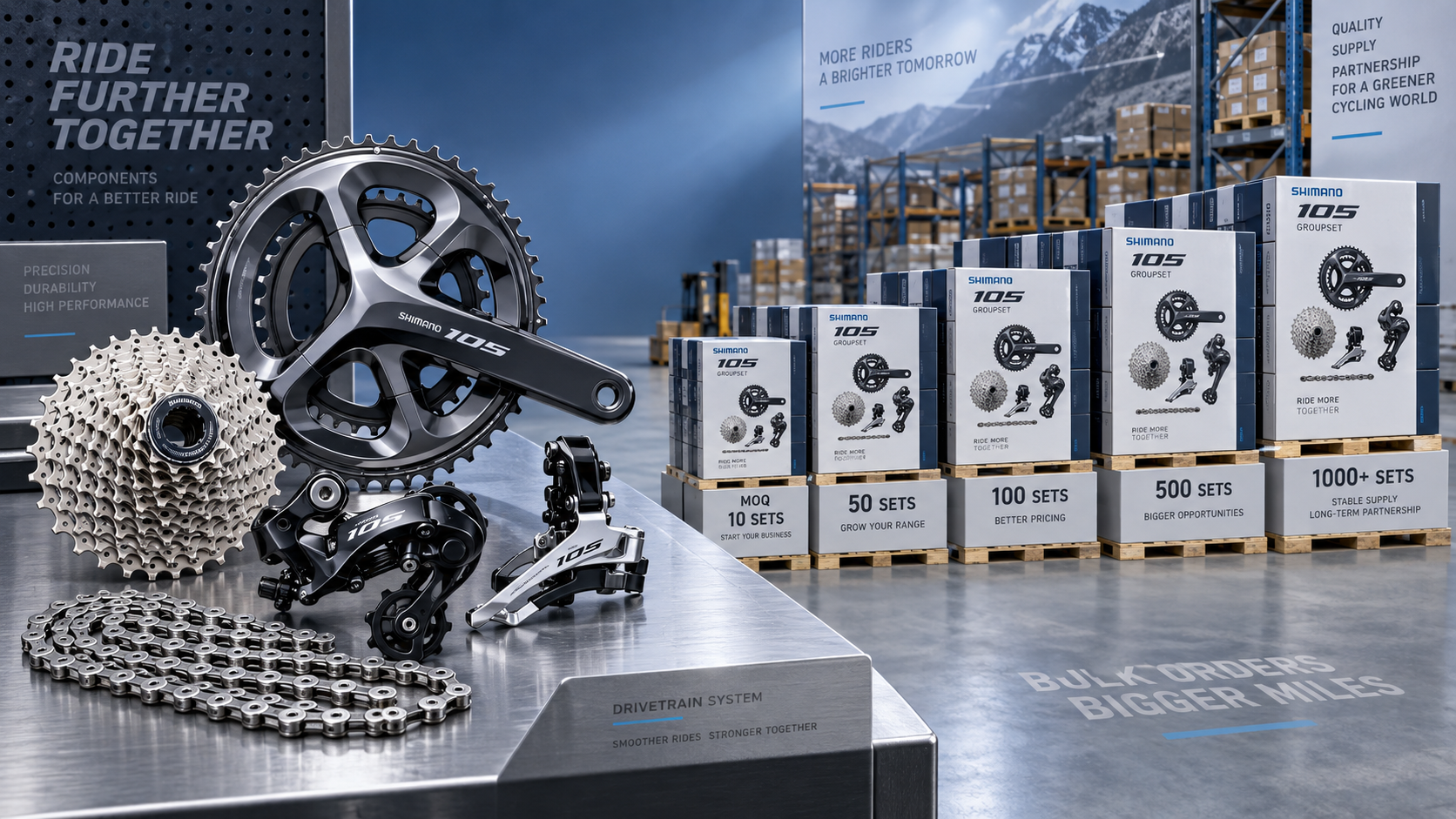
A lower unit price can hide a higher procurement cost when minimum order quantities exceed actual demand. For teams sourcing bike groupsets wholesale, MOQs influence pricing tiers, inventory exposure, cash flow, and supplier negotiating leverage. Mechanical and electronic groupsets can also carry different order thresholds, making like-for-like quote comparisons essential.
The practical question is not simply how many sets unlock the next discount. It is how many complete, compatible sets the business can use or sell before the cost of holding them consumes that discount. A groupset with the wrong crank length or cassette range is not useful inventory merely because it belongs to a popular product family.
Find out what the supplier’s MOQ actually covers
An MOQ may apply to the total purchase order, a groupset family, an individual component SKU, or a fixed configuration. Those are very different commitments. A supplier allowing mixed crank lengths and cassette ratios within one order offers more purchasing flexibility than one requiring the minimum quantity for every configuration.
This distinction matters when a bicycle brand builds several frame sizes. Overall demand may comfortably exceed the quoted minimum, while demand for one crank length remains small. If the minimum applies separately to that variant, the buyer can end up with enough drivetrain stock for the range but too much of the least-used configuration.
Ask whether the MOQ is a manufacturer requirement, a distributor’s commercial threshold, or simply the quantity required for the advertised price. Some suppliers may accept smaller orders at a different price. Others may require full cartons or production batches. The reason behind the threshold determines whether negotiation should focus on quantity, assortment, packaging, or delivery scheduling.
Also clarify whether “groupset” means a complete matched package. A quotation may exclude rotors, bottom brackets, batteries, chargers, or other installation items. A low price for an incomplete bundle should not be compared directly with a package that includes them.
Why larger orders can lower the quoted price
Volume discounts can reflect genuine savings. A supplier processes fewer transactions per unit, consolidates picking and packing, and may gain access to better upstream purchasing terms. Where an order involves assembly, dedicated packaging, or a production run, spreading setup costs across more units can also reduce the price.
However, the economics differ by supply channel. A distributor selling existing branded stock is not necessarily saving manufacturing costs when your order grows. Its discount may instead reflect stock clearance, sales targets, or the value of a predictable purchasing commitment. An OEM supply arrangement can have different conditions, including packaging, approved applications, and restrictions on resale.
That makes the shape of the price ladder worth examining. Request several quantity breaks rather than asking only for the supplier’s “best price.” Check whether each price applies to every set in the order or only to units above a threshold, and whether it depends on advance payment.
A discount tied to an unusually large commitment deserves another question: is it repeatable? A clearance offer may be attractive for a one-off build, but it is a weak basis for costing a bicycle model that needs replenishment throughout its sales cycle.
Compare the cost of usable stock, not just purchased stock
The invoice price is only the beginning. Freight, cargo insurance, applicable duties, brokerage, receiving checks, and required missing components all affect the cost of getting a groupset ready for use. Tax treatment depends on the destination and the buyer’s circumstances; recoverable tax should be distinguished from a permanent cost, although it may still create a cash-flow burden.
Keep landed cost separate from the costs created by holding inventory. Storage, financing, expected markdowns, and write-off exposure belong in the purchasing decision even though they are not normally part of the supplier’s quotation.
A useful comparison is total expected procurement cost divided by the number of complete, compatible sets expected to be used or sold within a defined planning period. If stock remains at the end, estimate its recoverable value conservatively rather than treating it as either worthless or equivalent to cash.
Consider a brand deciding between buying for a confirmed production run and stepping up to a larger discount tier. The extra sets save money only if their expected use or resale value justifies the additional cash commitment and holding risk. If the next bicycle specification is still undecided, that stock is effectively a bet on an unchanged drivetrain specification.
Run a slower-sales scenario as well as the forecast case. The uncomfortable result is often the useful one: it reveals whether the saving survives a delayed launch, a postponed assembly schedule, or weaker demand.
Mechanical and electronic orders need different checks
Do not assume electronic groupsets always have higher MOQs. The threshold depends on the brand, channel, availability, and configuration. What changes is the number of dependencies that must be checked before a volume commitment is safe.
For mechanical groupsets, confirm the approved relationship between shifters, derailleurs, cassette, chain, and crankset. Speed count alone does not establish compatibility. Brake actuation also matters: a hydraulic-brake package is not interchangeable with a cable-operated arrangement simply because the drivetrain has the same number of gears.
Electronic systems add battery, charging, wiring or wireless-generation, and firmware considerations. Check the manufacturer’s current compatibility documentation for the exact component codes. A discounted collection of individually genuine components can still be an unsuitable system if the generations do not work together.
Frame and wheel interfaces can create further costs. Verify freehub requirements, bottom-bracket fit, chainline, brake mounting, and any routing requirements. For e-bike builds, confirm that the drivetrain is suitable for the intended application rather than assuming a road or mountain-bike label establishes suitability.
This system-level view fits ACMD’s focus on precision drivetrains and two-wheeled mobility: procurement economics cannot be separated from mechanical integration. A lower component price offers little benefit if the selected package forces an unplanned wheel, frame, or assembly change.
The missing-component bottleneck
A large order of shifters and derailleurs does not guarantee a corresponding number of build-ready groupsets. Confirm availability across the full bill of materials, especially where suppliers assemble bundles from separate stock lines. Ask whether a component shortage permits substitutions, delays the whole shipment, or results in partial delivery. Substitutions should require written approval.
Negotiate the commitment structure before increasing quantity
The most useful concession is not always another price reduction. Mixed configurations, staged releases, or less demanding payment terms may protect more margin than a small discount on stock you do not need.
A blanket order with scheduled deliveries can give the supplier visibility while limiting stock physically held at your warehouse. But it does not automatically reduce financial exposure. If the agreement makes the whole quantity non-cancellable or payable upfront, you still carry much of the risk even when the supplier stores it.
- Mixed-SKU allowance: Can approved crank lengths and cassette ranges contribute to one volume threshold?
- Release terms: Are delivery dates fixed, adjustable, or subject to a final collection deadline?
- Payment trigger: Is payment due at order placement, allocation, dispatch, or after delivery?
- Commitment limits: Which quantities can be changed or cancelled, and what charges apply?
- Replenishment terms: Will smaller repeat orders retain an agreed price, and for how long?
There is a trade-off here. A supplier taking on storage and scheduling risk may offer a smaller discount. Compare that premium with your own financing and inventory costs before rejecting it. Flexibility has value, particularly when demand is spread across several bicycle specifications.
Keep channel and warranty terms inside the price comparison
Wholesale quotations can cover retail-boxed stock, OEM packaging, distributor inventory, or other sourcing channels. Packaging alone does not establish authenticity, and a low price alone does not establish a problem. The buyer needs traceable supply information, clear component identification, and documented warranty arrangements.
Confirm who handles claims, what evidence is required, and whether coverage applies in the intended market and application. Ask whether defective components are handled individually or require return of the complete package. Return freight, replacement delays, and incomplete claim documentation can erode an apparent purchasing advantage.
For an unfamiliar supplier or a new configuration, an inspection order may be worth the higher unit price. Agree on acceptance criteria before paying: exact part codes, condition, completeness, packaging expectations, and the remedy for discrepancies. A successful sample check supports the next decision; it does not replace controls on subsequent bulk shipments.
Choose the MOQ your demand can defend
A higher MOQ is easier to justify when configurations are stable, demand is supported by orders or a credible production schedule, and the extra stock can turn without straining working capital. A smaller commitment is often preferable when a product launch is unproven, interfaces are changing, or demand is fragmented across variants.
Before approving a bike groupsets wholesale order, put three options side by side: the smallest practical purchase, the next discount tier, and a staged-delivery proposal. Use the same component list, destination, payment assumptions, and planning period for all three. Include a slower-turnover case.
Choose the larger order only when its saving remains credible after those checks. If the discount relies on optimistic sales or unresolved compatibility, negotiate the order structure instead. The right MOQ is the quantity that supports reliable builds and replenishment without turning purchasing savings into excess stock.
Related News