
How do micromobility regulations vary across Europe?

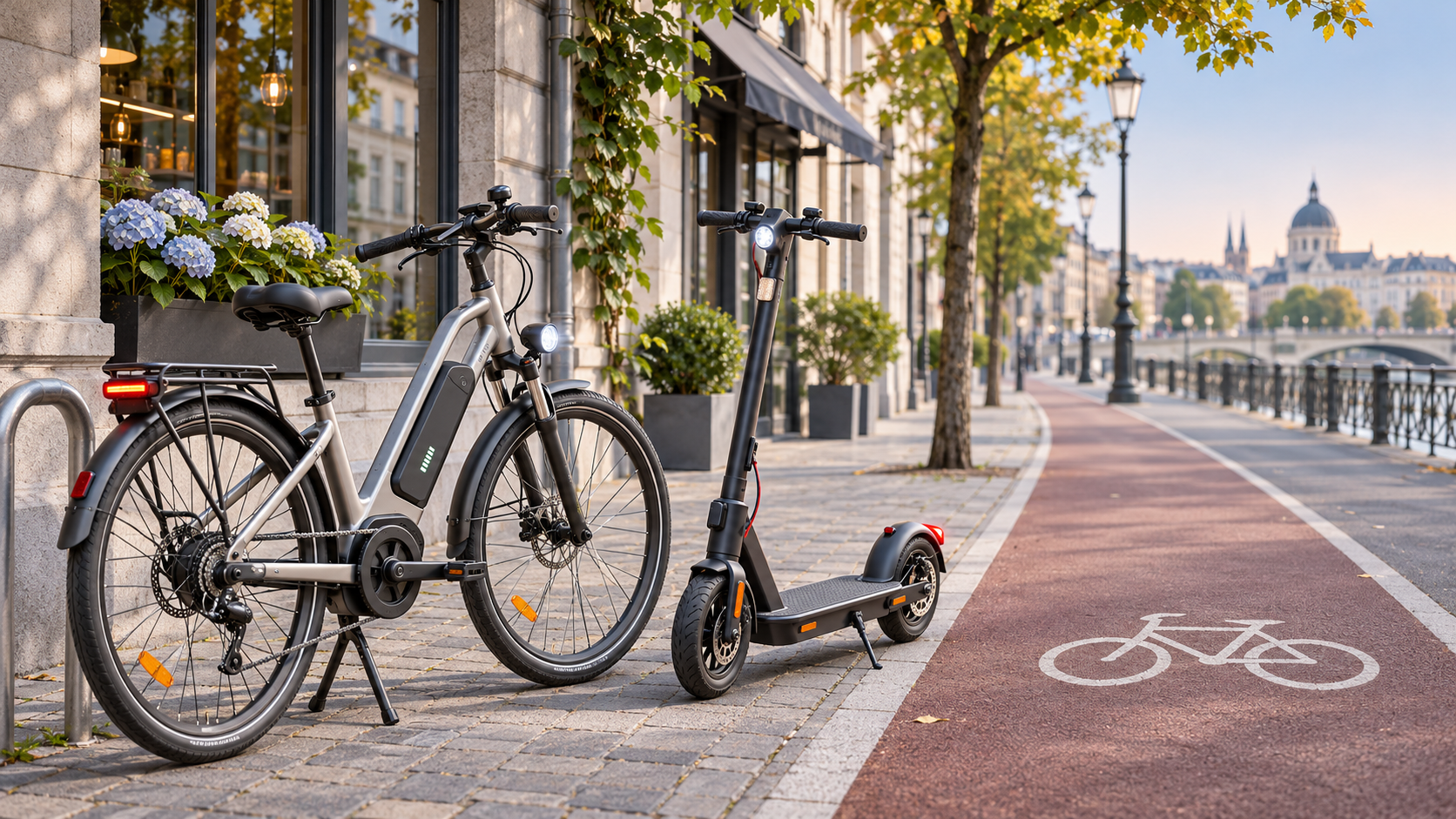
Micromobility regulations across Europe depend first on what a vehicle is legally classified as, and then on where and how it is used. An electrically assisted bicycle that meets the EU’s pedal-assist conditions can generally be treated as a bicycle for vehicle approval purposes. An e-scooter, by contrast, may be subject to a national approval scheme, an insurance requirement or restrictions that differ between private ownership and shared operation.
For riders and businesses, the practical consequence is that a vehicle suitable for one European market cannot automatically be used in another under the same conditions. Speed, motor assistance, equipment and insurance matter, but so do the rules governing cycle lanes, pavements, parking and local operating permits. The most useful starting point is to identify the vehicle category before comparing road rules.
Why there is no single European rulebook
European countries share parts of the legal framework for placing vehicles and products on the market, but road traffic rules remain substantially national. Cities may also control access to particular streets, parking areas and shared-service fleets within the powers granted to them by national law.
That creates three distinct questions:
- Can the vehicle be placed on the market? Product safety, technical documentation and, for certain motor vehicles, type-approval requirements are relevant here.
- Can it be used on public roads? National traffic law determines whether the vehicle is permitted and under what conditions.
- Where and how can it be ridden or parked? Road signs, local restrictions and operator permits can add another layer.
Meeting one test does not automatically satisfy the others. A scooter can be sold as a consumer product yet face restrictions on public-road use. A rental operator can have a technically compliant fleet but still need permission to operate in a particular city.
E-bikes: a relatively consistent starting point, with limits
For conventional pedal-assist e-bikes, the EU framework provides a useful baseline. Regulation (EU) No 168/2013 excludes from its motor vehicle type-approval scope cycles with pedal assistance equipped with an auxiliary electric motor having a maximum continuous rated power of 250 W, whose output is progressively reduced and cut off before the vehicle reaches 25 km/h, or sooner if the rider stops pedalling.
Those conditions are often shortened to “250 W and 25 km/h,” but the way assistance operates matters as well. A specification sheet showing those two numbers does not by itself settle the classification of a vehicle that can propel itself without pedalling. Limited assistance functions, such as walk assistance, require careful assessment against the applicable rules rather than a blanket assumption about every throttle or control.
The exclusion from Regulation 168/2013 is also specific: it removes qualifying cycles from that regulation’s vehicle type-approval scope. It does not exempt them from product safety obligations or make all national cycling rules identical. Rules on helmets, age, equipment, cycle-lane use and other aspects of riding can still differ between jurisdictions.
Faster or more powerful electrically assisted cycles may fall within a motor vehicle category and require a different approval pathway. A speed pedelec, for example, should not be assessed as an ordinary pedal-assist bicycle simply because it has pedals. Depending on its classification and the country of use, registration, insurance, licensing, helmet and road-access requirements may follow.
For a manufacturer or researcher, the implication is straightforward: record the assistance logic as well as rated power and cut-off speed. For a fleet operator, the same distinction affects more than the purchasing specification; it can determine who may ride the vehicle and which routes are available.
E-scooters show the sharpest national differences
Unlike the familiar 250 W/25 km/h starting point for conventional pedal-assist e-bikes, there is no single set of road-use conditions that makes an e-scooter legal throughout Europe. The following examples show why the country of use must be checked separately from the country where a scooter was bought.
These examples are a guide to different regulatory models, not a substitute for checking the precise vehicle and jurisdiction. The United Kingdom is outside the EU, and rules can differ among its constituent jurisdictions; the example above refers specifically to Great Britain. Within EU countries, national measures and municipal ordinances may also change independently of EU product legislation.
Germany illustrates how a relatively small specification difference can affect market access. Its framework for small electric vehicles sets a maximum design speed of 20 km/h. A product designed around a higher limit for another market may need more than a software setting change: the vehicle must satisfy the applicable German approval and insurance requirements. The relevant question is whether the particular vehicle and configuration are approved for the intended use.
France takes a different approach to speed, but the comparison should not stop at the numerical limit. Insurance, rider conduct, equipment and the local allocation of road space all affect lawful operation. A scooter that satisfies a speed restriction still needs to meet the other conditions attached to its category.
Speed limits are only one part of the riding rules
Search results often compare countries by maximum e-scooter speed. That is useful for an initial screen, but it can obscure the rules that determine whether a journey is practical.
Road and cycle-lane access. Some jurisdictions direct e-scooters towards cycle infrastructure where it exists, while others apply different conditions based on the road, vehicle category or local signs. Pavement riding is commonly restricted, but the scope of any prohibition and its exceptions must be checked locally. A permitted vehicle may still be excluded from a particular pedestrian zone.
Age and helmets. Minimum rider ages and helmet duties are not uniform. Requirements can depend on the rider’s age, the type of vehicle and whether it is privately owned or part of a rental service. A helmet requirement for a speed pedelec should not be assumed to apply in the same way to an ordinary e-bike, or vice versa.
Insurance and registration. Insurance can be compulsory even when a vehicle is small, light and used for short trips. Germany’s insurance sticker for eligible small electric vehicles is a visible example. France also requires liability insurance for motorised personal transport devices. Elsewhere, obligations may turn on vehicle classification and national implementation of motor insurance rules. A retailer’s product warranty or an operator’s damage waiver should not be treated as proof that the required third-party cover is in place.
Parking. A vehicle may be lawful to ride on a route but unlawful to leave at the destination. Municipal rules can prohibit obstructive parking, limit parking to designated areas or impose additional conditions on shared fleets. For operators, parking compliance affects fleet distribution and street access; for riders, it can determine whether a rental trip can be ended in a particular location.
Standards, approval and certification serve different purposes
For manufacturers and buyers, “European compliant” is too broad to answer the regulatory question. It is more useful to ask which legislation applies, which technical standards have been used and whether the vehicle needs a formal approval before road use.
EN 15194 is a relevant European standard for electrically power assisted cycles within its scope. EN 17128 addresses certain personal light electric vehicles. Their applicability depends on the product and on the version of the standard relevant to the assessment. A reference to a standard can support a conformity assessment, but the standard’s role under particular legislation depends on whether and how it is cited for that legislation.
CE marking is another distinction that is easy to miss. Where applicable product legislation requires it, the marking represents the manufacturer’s declaration that the product meets relevant requirements. It is not a universal licence to ride on public roads, nor does it replace national vehicle approval, registration or insurance where those are required.
A useful documentation review therefore starts with the complete vehicle configuration: motor rating, maximum assisted or design speed, assistance controls, braking and lighting equipment, battery and charger, and any software settings that affect performance. It then links that configuration to the applicable declaration of conformity, test evidence and, where required, vehicle approval documents. Accessories and later modifications matter if they change the vehicle’s classification or its compliance with the approved configuration.
For higher-speed electric two-wheelers, the distinction becomes more pronounced. An electric motorcycle is assessed through the relevant motor vehicle framework, not simply as a larger micromobility device. The applicable category drives the approval and road-use questions; the label used in marketing does not settle them.
Shared fleets add a city-level layer
A shared scooter operator must deal with both the vehicle and the service. A city may set conditions through permits or contracts covering fleet size, operating areas, parking, data reporting and how quickly incorrectly parked vehicles must be addressed. The details depend on the municipality and the legal powers under which the scheme operates.
Geofencing can help an operator apply local conditions by slowing a vehicle in a designated area, preventing trips from ending outside an approved zone or directing users to parking locations. It should be assessed as an operational control: its usefulness depends on location accuracy, network availability, map maintenance and how the service handles boundary cases. The presence of geofencing alone does not establish that a fleet complies with every local rule.
Private ownership raises a different question. A city’s permission for an operator to run a shared fleet does not necessarily extend to privately owned vehicles, and permission to ride does not necessarily confer the right to park anywhere. Comparing shared and private use separately avoids a common mistake when evaluating a market.
How to assess a vehicle for a specific route or market
A practical assessment begins with the exact product and the intended use, rather than a generic category such as “micromobility.” An e-bike for employee commuting, a privately owned scooter and a shared fleet may encounter different obligations even in the same city.
- Identify the vehicle configuration. Establish its power, speed, means of propulsion and any approval already held. Check whether an assistance setting or modification changes its legal treatment.
- Check national market and road rules. Identify the applicable product requirements and whether public-road use requires approval, registration, insurance, a licence or specific equipment.
- Check the intended location. Review local rules for cycle lanes, pedestrian areas, parking and, for shared services, permits and operating zones.
- Match the evidence to the use. Keep the relevant conformity and approval documents with the vehicle specification, and verify that insurance covers the intended rider and activity.
For cross-border deployment, repeat that assessment for each destination rather than relying on the strictest-looking speed limit alone. A vehicle configured to travel more slowly may still lack the approval, equipment or insurance required in the next country.
Because legislation and local operating conditions can change, the final check should use the relevant national transport authority, road authority or municipality, alongside the manufacturer’s documentation for the exact model. The value of a comparison lies in showing where the rules diverge; the decision to ride, purchase or deploy depends on the vehicle and place in question.
Related News