Precision Drivetrain Upgrades That Reduce Service Downtime

Service downtime rarely begins with a dramatic failure. In advanced two-wheel platforms, it usually starts with small drivetrain inconsistencies that grow into repeat adjustments, premature wear, and unclear fault tracing.
That is why precision drivetrain upgrades matter. When shift systems, chain paths, cassettes, pulleys, sensors, and alignment interfaces are improved together, maintenance becomes more predictable and less disruptive.
Across e-bikes, performance bicycles, smart mobility vehicles, and high-speed electric motorcycles, the same pattern appears. Better drivetrain precision does not just improve riding feel. It reduces service interruptions and stabilizes workshop flow.
Why drivetrain precision has become a service issue
A modern precision drivetrain operates inside a tighter tolerance window than older systems. Lightweight materials, higher torque loads, compact frame designs, and electronic shifting all raise the consequences of minor misalignment.
In ACMD’s mobility coverage, this is especially visible where low-carbon transport and high-performance cycling intersect. Vehicles are expected to stay light, efficient, quiet, and digitally responsive at the same time.
That expectation changes maintenance logic. A drivetrain no longer serves only as a power transfer mechanism. It becomes a system that affects diagnostics time, spare parts turnover, rider confidence, and fleet availability.
In practical terms, if a shift issue returns after adjustment, the real cost is not one cable turn or one firmware check. The real cost is lost bench time and reduced service reliability.
What a precision drivetrain upgrade actually includes
The phrase precision drivetrain is often used loosely. In service work, it should mean a drivetrain package designed to hold adjustment longer, wear more evenly, and reveal faults faster.
That package may include mechanical parts, electronic controls, and structural interfaces. Not every system needs a complete replacement. Targeted upgrades often produce the best uptime gains.
Core upgrade areas
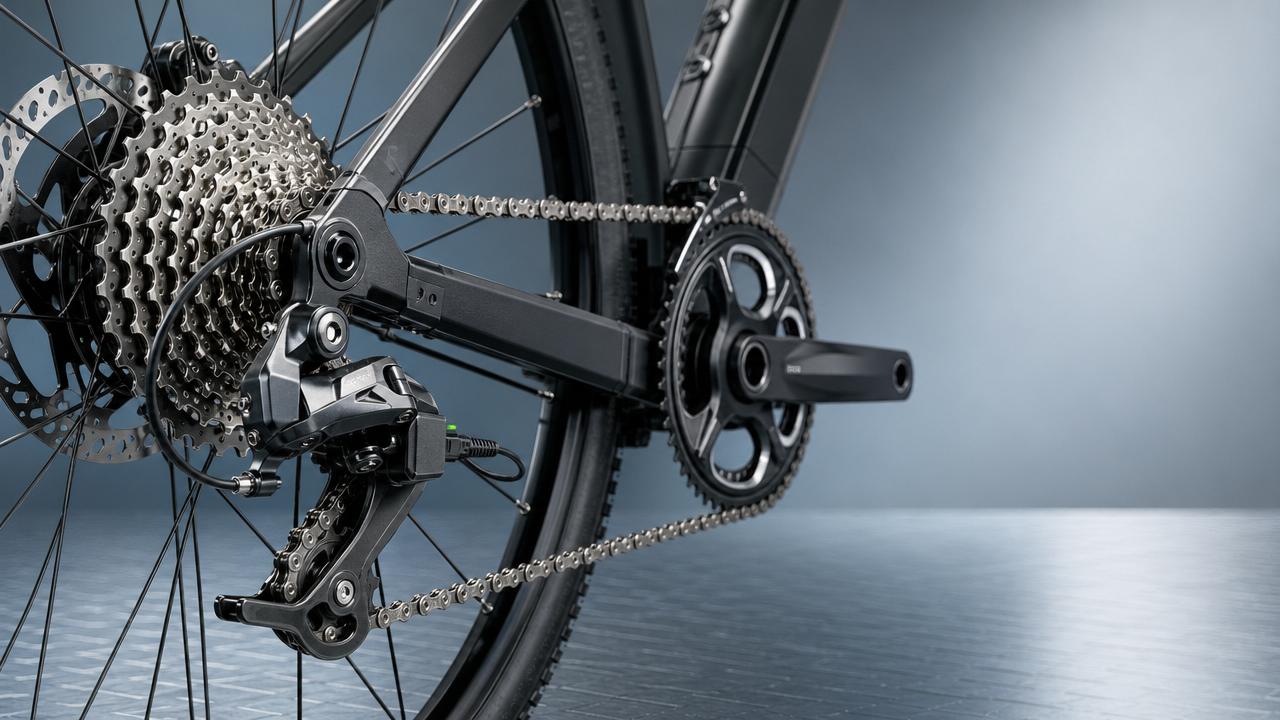
- High-stiffness derailleur hangers and alignment-critical mounting points
- Premium cassettes and chainrings with improved machining accuracy
- Low-friction chains, coated pins, and wear-resistant rollers
- Sealed pulley wheels and cage assemblies with tighter bearing tolerance
- Electronic derailleurs with faster indexing consistency and stronger interference resistance
- Wiring, connectors, or wireless modules less prone to vibration-related faults
- Torque-managed interfaces between motor output and rear transmission in e-mobility systems
The important point is system coherence. A precision drivetrain upgrade works best when compatibility, tolerance stack-up, and load path are reviewed together rather than part by part.
Where downtime usually comes from
Many recurring service delays are not caused by catastrophic wear. They come from accumulated micro-errors that make the drivetrain unstable under real riding loads.
This is where a precision drivetrain creates measurable value. It reduces the number of small, recurring faults that consume time without appearing serious on first inspection.
Why the issue is bigger in today’s mobility market
The current mobility landscape is more demanding than the traditional bicycle service environment. Urban micro-mobility platforms are used harder, charged more often, and expected to stay available with minimal interruption.
E-bikes add motor torque to familiar chain-driven systems. Smart e-scooters introduce connected diagnostics and compact packaging. Performance bikes pursue lower weight while keeping precise shifting under extreme cadence changes.
ACMD tracks these shifts closely because they connect materials science, transmission design, and low-carbon transport policy. As vehicles become lighter and smarter, the margin for drivetrain inconsistency gets smaller.
That trend explains the growing interest in precision drivetrain architecture, especially for service environments managing mixed platforms and variable usage patterns.
The strongest upgrade paths for reducing service pressure
Not every upgrade delivers equal downtime reduction. Some parts improve performance feel but do little for service stability. Others directly cut repeat visits and troubleshooting hours.
1. Stabilize alignment first
A precision drivetrain cannot stay precise on a drifting foundation. Hangers, dropout interfaces, axle seating, and derailleur mounts should be checked before replacing premium shift components.
This matters even more on carbon fiber frames and lightweight rear triangles. Stiffness, impact history, and mounting accuracy all influence indexing retention.
2. Match wear parts to actual load cycles
A city commuter e-bike, a rental micro-mobility platform, and a racing bike do not stress the drivetrain in the same way. Upgrade logic should follow duty cycle, contamination level, and torque profile.
Higher-spec chains and cassettes often lower total service burden when they hold pitch accuracy longer and protect adjacent components from uneven wear.
3. Improve electronic shift consistency
On advanced systems, electronic shifting faults can look mechanical at first. Signal interference, low battery stability, firmware mismatch, or connector fatigue can create misdiagnosis loops.
A precision drivetrain upgrade may therefore include cleaner cable routing, better connector sealing, stronger wireless protocols, and version control for software calibration.
4. Reduce contamination sensitivity
Fine tolerances are valuable only when they survive road grit, wash cycles, and weather exposure. Better seals, corrosion-resistant coatings, and service-friendly pulley designs can extend maintenance intervals significantly.
How to judge whether an upgrade is worthwhile
A useful upgrade should be measured against downtime reduction, not just catalog prestige. The best precision drivetrain decisions usually answer a few direct questions.
- Does the part hold alignment or indexing longer than the current setup?
- Does it reduce diagnosis ambiguity when faults appear?
- Is it compatible with the frame, motor system, cassette range, and firmware environment?
- Will it lower total wear across chain, cassette, pulley, and shift actuator?
- Can it be serviced quickly without uncommon tools or unstable settings?
If the answer is yes on most of these points, the upgrade is likely to support uptime rather than only improve nominal performance.
Typical service scenarios across two-wheel platforms
Different vehicle categories reveal different precision drivetrain priorities. Looking at the application context helps avoid generic replacement strategies.
E-bikes
Motor-assisted torque accelerates chain and cassette fatigue. Upgrades should favor load-rated wear parts, stable indexing, and interfaces that resist repeated shock under assisted climbing.
Smart urban mobility fleets
Fleet uptime depends on repeatability. A precision drivetrain setup with standardized parts, clear diagnostics, and low contamination sensitivity reduces inspection time and unplanned returns.
Competitive bicycles
Performance demands expose any tolerance weakness immediately. Here, precision drivetrain upgrades often focus on electronic response speed, derailleur rigidity, and drivetrain friction control.
High-speed electric motorcycles
Where chain-driven secondary transmission is used, heat, torque pulse, and vibration become dominant service factors. Upgrade choices must reflect mechanical load, not bicycle-style assumptions.
A practical way to move forward
The most effective next step is not a blanket parts upgrade. It is a short audit of repeat drivetrain complaints, adjustment frequency, wear patterns, and fault resolution time.
From there, map the highest downtime sources to the most relevant precision drivetrain interventions. In some cases, a stiffer hanger solves the issue. In others, the answer is chain specification, electronic shielding, or better load matching.
For operations tracking developments through ACMD, the broader lesson is clear. Precision in transmissions is no longer only a performance topic. It is a maintenance strategy tied to reliability, decarbonized mobility, and long-term service efficiency.
When evaluating the next upgrade cycle, focus on the parts and interfaces that shorten diagnosis, extend service intervals, and keep the precision drivetrain stable under real-world use. That is where downtime starts to shrink in a meaningful way.
Related News