
Traction Battery Systems Safety: Key Failure Risks and Controls

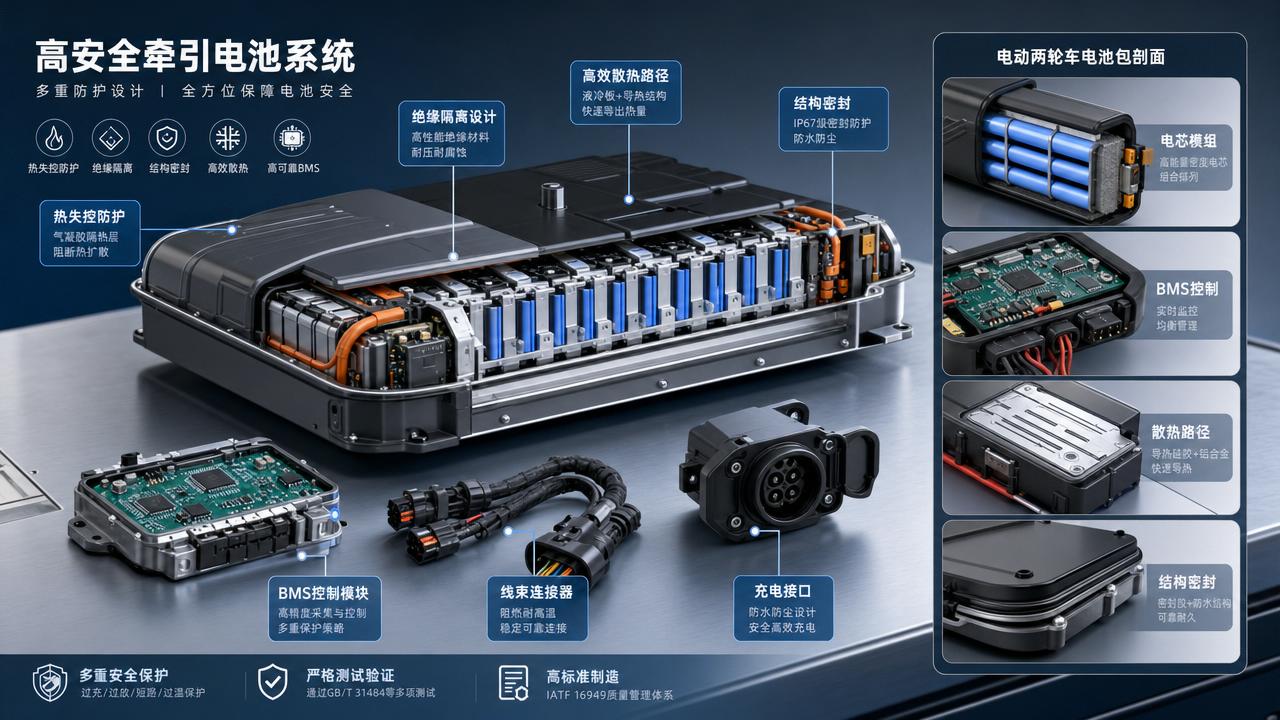
Traction Battery Systems Safety: Key Failure Risks and Controls
Traction battery systems safety is now a frontline concern across e-bikes, e-scooters, and high-speed electric motorcycles.
For quality and safety teams, the challenge is no longer theoretical.
A small cell defect, a damaged harness, or a weak charging control can quickly turn into smoke, fire, recalls, or transport restrictions.
That is why traction battery systems safety must be managed as a system issue, not a single component check.
From recent market shifts, the stronger signal is clear.
Products are getting lighter, faster, and more energy-dense, while regulations and customer expectations are becoming stricter.
This also means battery risk controls must move earlier into design, sourcing, assembly, and field monitoring.
Why traction battery systems safety fails in the real world
In practice, most failures do not come from one dramatic event.
They come from stacked weaknesses that pass through design review, incoming inspection, production, logistics, and usage conditions.
A battery pack may pass a bench test, yet still fail after vibration, moisture, repeated fast charging, or careless service work.
That is the core lesson of traction battery systems safety.
The pack, BMS, enclosure, connectors, firmware, charger, and thermal path must work together under abnormal conditions, not only normal ones.
- Cell-level defects can trigger pack-level propagation.
- Assembly variation can weaken insulation and compression control.
- Charging misuse can bypass intended protective logic.
- Mechanical abuse can create delayed internal damage.
- Poor service traceability can hide recurring field issues.
The highest-risk failure modes to watch
1. Thermal runaway
Thermal runaway remains the most serious traction battery systems safety event.
It can start from internal short circuits, overcharge, contamination, separator damage, or external heating.
Once initiated, heat, gas, and fire can spread rapidly across adjacent cells.
For compact urban mobility platforms, limited space makes propagation control even harder.
2. Insulation failure and electric shock risk
Insulation failure is often underestimated until water ingress, abrasion, or contamination appears in the field.
Damaged insulation can create leakage current, signal errors, arcing, or unsafe touch voltage.
This risk grows when routing spaces are tight and service access is poor.
3. Charging and overcharge faults
Charging faults are a frequent entry point for traction battery systems safety incidents.
The causes include incompatible chargers, BMS calibration drift, connector heating, firmware logic gaps, and unbalanced cells.
A pack may look stable at delivery but become vulnerable after hundreds of partial cycles.
4. Mechanical abuse and vibration damage
Battery packs on two-wheeled vehicles face drops, curb hits, potholes, crush loads, and long-term vibration.
The visible housing may survive, while internal tabs, welds, or cell edges become compromised.
This delayed-damage pattern makes traction battery systems safety difficult to assess without teardown data.
5. Thermal management imbalance
Not every pack has active cooling, but every pack has a thermal behavior.
Uneven heat paths, blocked vents, poor gap materials, or dense packaging can create hot spots.
Hot spots accelerate aging, increase resistance, and reduce the safety margin during charging and discharge.
Root causes behind recurring safety events
When incidents repeat, the same root causes usually appear.
The issue is often not lack of testing.
It is weak linkage between design assumptions and production reality.
- Cell sourcing changes without equivalent validation.
- Incomplete DFMEA and PFMEA updates after design revisions.
- Poor torque, weld, and sealing process control.
- Limited traceability for lots, operators, and rework records.
- Field complaints treated as isolated cases, not trend signals.
In actual operations, traction battery systems safety improves fastest when teams connect warranty data, lab findings, and process audits into one decision loop.
Practical control strategies that reduce risk
Strengthen cell and supplier controls
Traction battery systems safety starts with disciplined supplier management.
Require clear change notification rules for cells, separators, electrolytes, tabs, and vent structures.
Incoming inspection should verify more than dimensions and voltage.
It should include lot consistency, resistance spread, appearance defects, and storage history.
Design for abuse, not ideal use
A robust pack is designed for rain, drops, misuse, and charging uncertainty.
Spacing, compression, venting, flame barriers, fuse strategy, and cable routing all matter.
Where packaging is constrained, trade-offs should be documented and retested after each structural change.
Control charging as a full system
Safe charging depends on charger hardware, connector quality, communication logic, and BMS thresholds.
Review charge cut-off accuracy, temperature sensing placement, balancing behavior, and fault response timing.
If battery swapping is used, connector wear and mating contamination require extra attention.
Tighten manufacturing discipline
Many traction battery systems safety failures are introduced during assembly.
Critical points include weld quality, insulation placement, seal integrity, adhesive cure control, and foreign particle prevention.
End-of-line testing should simulate realistic fault conditions, not only basic pass or fail checks.
Useful standards and verification focus
For traction battery systems safety, compliance should support engineering judgment, not replace it.
Depending on product category and market, teams often reference UL 2271, UL 2849, EN 15194, UN 38.3, IEC-related requirements, and local fire codes.
However, passing a standard test does not automatically prove field robustness.
Verification should focus on the failure mechanisms most relevant to the use case.
A simple action framework for ongoing control
If traction battery systems safety needs immediate strengthening, start with a short, disciplined review cycle.
- Map the top five field failure patterns by model, lot, and charging condition.
- Link each pattern to design controls, process controls, and test coverage.
- Recheck high-risk interfaces such as cells, BMS, connectors, and sealing points.
- Run abuse-based validation on revised packs, not only nominal cycling tests.
- Create closed-loop corrective action with supplier, factory, and service teams.
This approach keeps traction battery systems safety visible as a daily management topic, not a once-a-year audit item.
Final takeaway
Traction battery systems safety depends on disciplined system thinking.
The main risks are already well known: thermal runaway, insulation breakdown, charging faults, mechanical abuse, and thermal imbalance.
What separates stable products from risky ones is how early those risks are identified and how consistently controls are enforced.
For brands, OEMs, and safety teams in electric mobility, the practical next step is clear.
Review the full battery pathway, from cell sourcing to field charging behavior, and tighten the weak links before the next incident does it for you.
Related News