
Carbon Fiber Manufacturing Risks Behind Lightweight Frame Claims

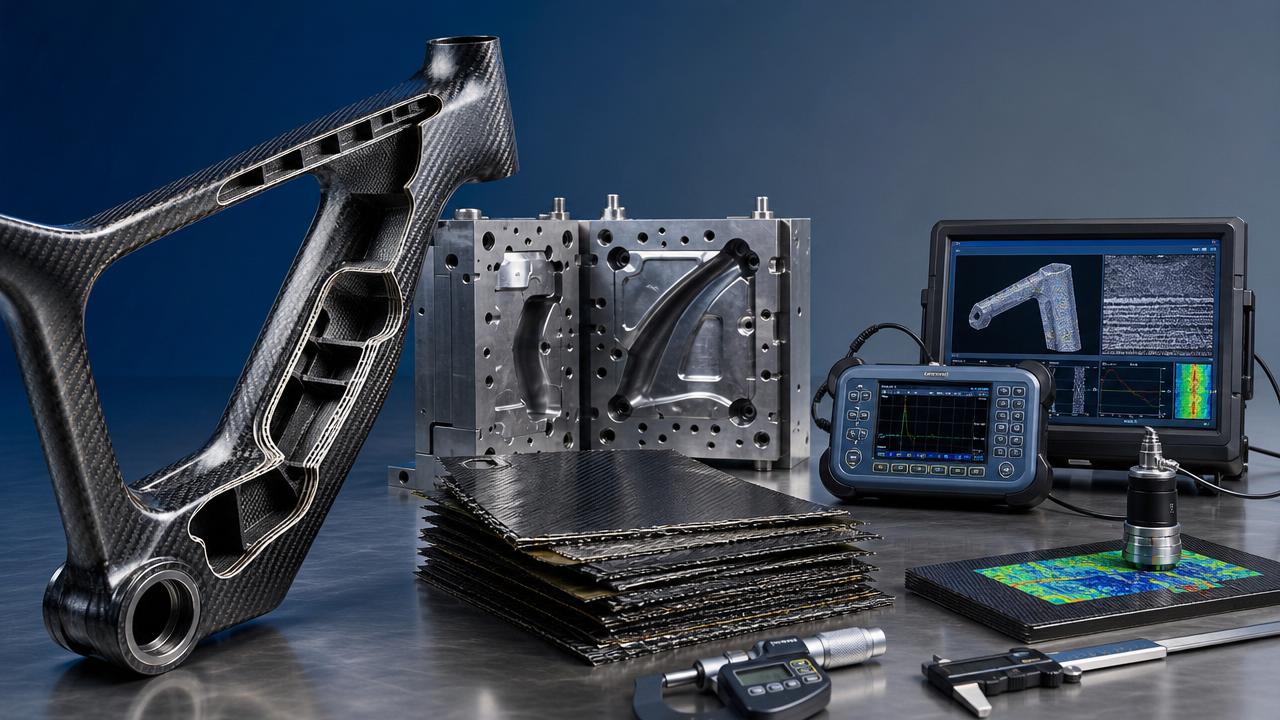
Lightweight frame claims can look convincing on a data sheet, yet the true quality signal sits deeper inside carbon fiber manufacturing. Small process deviations in fiber placement, resin mixing, curing temperature, tooling stability, and documentation can create large downstream consequences. Those consequences include warranty exposure, certification delays, inconsistent ride performance, and avoidable brand damage. A reliable evaluation framework helps separate genuine engineering capability from marketing language.
Why a Checklist Matters in Carbon Fiber Manufacturing
Carbon fiber manufacturing is not a single skill. It is a chain of tightly linked controls. Material selection, layup sequencing, mold accuracy, cure profiles, trimming methods, and inspection routines must all work together.
A frame may pass a weight target while still carrying hidden voids, resin-rich zones, or bonding weakness. Those issues often remain invisible until fatigue cycles, impact events, or field failures expose them.
For mobility, sports tech, and lightweight transport products, this matters beyond pure performance. Regulatory compliance, repeatability across batches, and long-term structural integrity are now part of the commercial value of every composite frame program.
Core Verification Checklist for Lightweight Frame Claims
Use the following checklist to assess whether carbon fiber manufacturing capability is mature enough to support premium frame claims at scale.
- Verify raw material traceability from fiber tow and resin system to lot number, storage condition, shelf life, and batch release record before any production approval.
- Check prepreg handling discipline, including freezer control, thaw time, humidity monitoring, out-time logging, and clear rejection rules for expired materials.
- Review layup work instructions for ply orientation, overlap tolerance, drop-off transition design, and local reinforcement zones around head tube, bottom bracket, and dropouts.
- Inspect mold design and maintenance records to confirm dimensional stability, venting performance, release consistency, and wear control across repeated cure cycles.
- Confirm resin content control through measured process windows rather than operator feel, because excess resin can increase weight while reducing optimized stiffness-to-mass balance.
- Audit bladder molding or internal compaction methods to ensure pressure distribution is consistent and capable of minimizing wrinkles, bridges, and internal voids.
- Request documented cure profiles showing ramp rate, dwell time, peak temperature, and pressure history, then compare them against resin supplier specifications.
- Evaluate bonding procedures for inserts and subassemblies, including surface preparation, adhesive selection, bondline thickness, and contamination prevention controls.
- Review non-destructive inspection capability such as ultrasonic testing, tap testing standards, borescope checks, or CT sampling for high-risk geometries.
- Ask for fatigue, impact, and overload test data tied to actual production configurations, not only prototype samples built under exceptional laboratory conditions.
- Check whether trimming, drilling, and machining operations protect fibers from edge delamination, heat damage, and hidden crack initiation around stressed interfaces.
- Measure process repeatability across multiple lots, because strong first articles do not prove stable carbon fiber manufacturing under commercial production pressure.
What Good Evidence Looks Like
Strong suppliers usually provide more than polished presentations. They can show traveler sheets, cure logs, scrap trends, incoming inspection records, CAPA history, and test reports linked to serial numbers.
This level of evidence matters because carbon fiber manufacturing quality is proven by control discipline, not by isolated sample excellence. Repeatable documentation often predicts repeatable structural outcomes.
Application-Specific Considerations
Road and Performance Bicycle Frames
In performance cycling, weight claims receive immediate attention. However, ultra-light targets can tempt aggressive ply reduction in low-visibility zones. That may weaken impact tolerance and reduce fatigue margin under sprint loads.
Carbon fiber manufacturing for race-oriented frames should prove balanced engineering. Torsional stiffness, bottom bracket stability, fork interface durability, and crash survivability all matter alongside headline gram savings.
E-Bikes and Urban Mobility Platforms
E-bikes place different stress on composite structures. Motor torque, battery mass, vibration, and frequent curb impacts create multi-directional loads that differ from purely human-powered riding patterns.
Here, carbon fiber manufacturing must address local reinforcement around motor mounts, battery enclosures, charging ports, and cable routing paths. Poorly controlled cutouts or bonded inserts can become early failure points.
Aerospace-Inspired Lightweight Programs
Some frame suppliers reference aerospace-grade fibers to signal advanced capability. That phrase alone proves little. Aerospace-derived material does not guarantee aerospace-level process control or validation culture.
The useful question is whether carbon fiber manufacturing follows disciplined composite engineering principles: controlled environments, validated cure windows, traceable materials, and defect detection methods matched to geometry risk.
Commonly Overlooked Risks Behind Lightweight Claims
Resin Drift Across Production Batches
Even when fiber grade stays constant, resin variability can alter viscosity, bonding behavior, and cure response. In carbon fiber manufacturing, small chemistry drift may change void content and long-term fatigue behavior.
Operator-Dependent Layup Precision
Manual layup remains common in premium frames. If work instructions are weak or training is inconsistent, ply angle error and overlap inconsistency can quietly accumulate. Weight may stay low while structural reliability falls.
Tool Wear and Dimensional Creep
Molds degrade over time. Slight wear can influence wall thickness, alignment, and surface finish. Carbon fiber manufacturing audits should therefore include preventive maintenance intervals and dimensional verification evidence.
Overreliance on Cosmetic Inspection
A clean paint finish is not a structural certificate. Internal porosity, bridging, or local delamination may sit below attractive cosmetics. Visual appeal should never replace process data and structural testing.
Prototype-to-Production Mismatch
Hand-selected prototype builds often outperform regular production. Carbon fiber manufacturing reviews should compare development samples with routine output, scrap rate, and field-return history before trust is established.
Practical Execution Steps
- Build a supplier audit form that covers materials, layup, curing, bonding, testing, and traceability in one document.
- Request three sets of evidence: engineering standards, recent production records, and destructive or non-destructive validation data.
- Compare at least two lots, not one sample, to judge repeatability in carbon fiber manufacturing performance.
- Tie lightweight claims to test outcomes, warranty assumptions, and expected use conditions rather than marketing positioning.
- Set acceptance thresholds for voids, weight tolerance, dimensional accuracy, and fatigue cycles before commercial release.
Useful Questions During Evaluation
Ask how scrap is categorized, how cure deviations are dispositioned, how insert bonds are verified, and how field failures feed back into revised process control. These questions reveal operational maturity quickly.
It is also valuable to ask which step in carbon fiber manufacturing creates the highest defect risk. Honest, specific answers often indicate stronger technical governance than broad claims of perfection.
Conclusion and Next Action
The promise of a lightweight frame becomes credible only when carbon fiber manufacturing controls are visible, documented, and repeatable. Low mass alone is not proof of advanced engineering. Durable performance depends on disciplined execution from raw material intake through final inspection.
The most effective next step is to convert these points into a formal qualification checklist, then score each supplier against objective evidence. That approach reduces sourcing risk, improves product confidence, and protects long-term brand value in competitive mobility markets.