
Carbon Fiber Manufacturing: What Drives Frame Consistency?

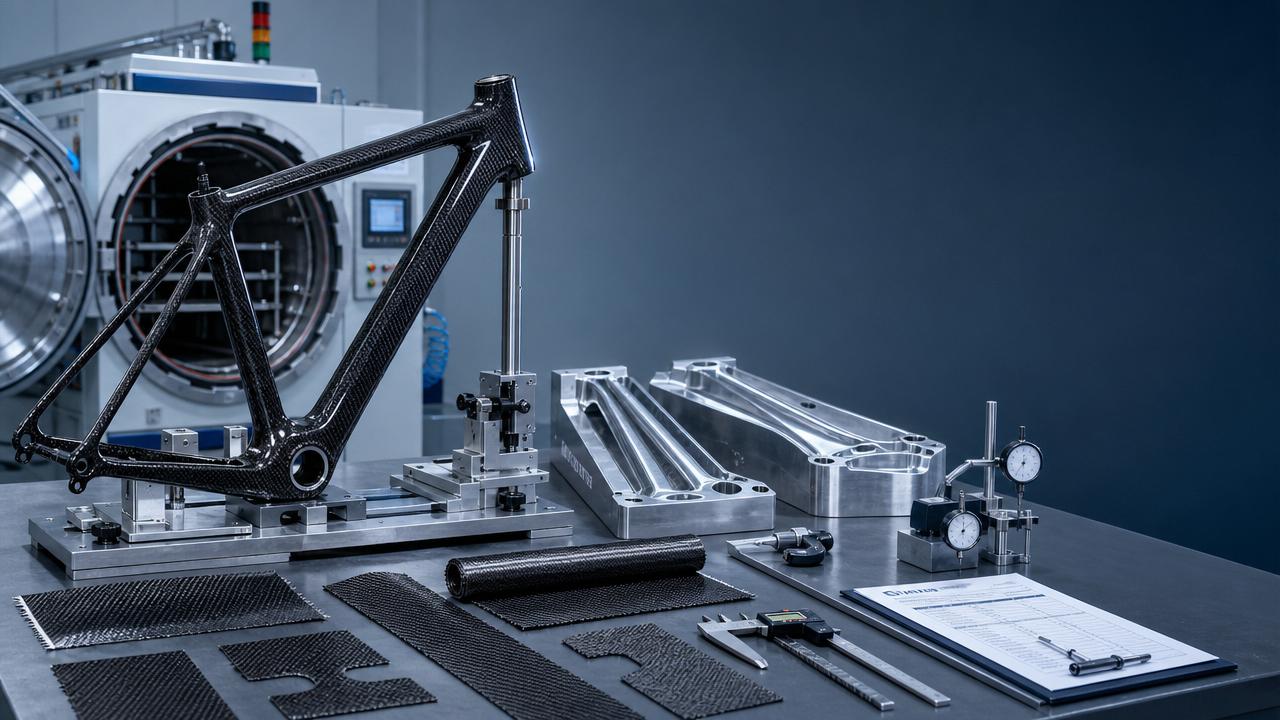
In carbon fiber manufacturing, frame consistency separates proven engineering from attractive but unstable output. A frame may meet nominal weight once, yet still vary in stiffness, durability, or ride feel between batches. True consistency depends on process discipline across layup, resin management, tooling, curing, trimming, and verification. When these variables are controlled together, the final structure can repeatedly match its design intent rather than merely approach it.
Why a Checklist Matters in Carbon Fiber Manufacturing
Carbon fiber manufacturing involves many coupled steps, and small deviations often accumulate before they become visible. A minor resin ratio error, a shifted ply angle, or uneven mold temperature can create measurable differences in lateral stiffness and fatigue life.
A checklist approach makes consistency easier to judge because it translates abstract quality claims into observable controls. Instead of asking whether a frame is “high quality,” it is better to verify whether the process reliably prevents variation at each critical stage.
Core Checklist: What Drives Frame Consistency
Use the following checkpoints to assess whether carbon fiber manufacturing is likely to deliver repeatable frame performance.
- Define ply orientation precisely, because even small angular drift changes torsional response, load transfer through joints, and local buckling resistance under repeated riding stress.
- Control prepreg storage conditions tightly, since temperature exposure and out-time directly affect resin flow, tack behavior, consolidation quality, and long-term laminate stability.
- Standardize layup sequencing rigorously, ensuring operators place reinforcement patches, overlap zones, and transition plies in the same order every single production cycle.
- Verify cutting accuracy carefully, because fiber distortion, frayed edges, and inconsistent nesting can alter local fiber volume fraction and weaken stress concentration zones.
- Measure resin content consistently, since excess resin adds weight without strength, while low resin risks dry spots, voids, and poor interlaminar bonding.
- Maintain mold dimensional stability, because worn tools, thermal expansion mismatch, or poor alignment can shift tube geometry and assembly tolerances.
- Stabilize bladder or mandrel pressure during forming, as pressure fluctuation influences compaction, wall thickness uniformity, and internal surface quality.
- Calibrate cure temperature profiles exactly, because ramp rate, dwell time, and cooling behavior determine resin crosslinking and residual internal stress.
- Inspect consolidation quality with structured methods, using ultrasonic checks, section analysis, or tap testing to detect voids and incomplete bonding.
- Track trimming and drilling repeatability, since post-cure machining can introduce delamination, dimensional scatter, and hidden damage around interfaces.
- Link test data to each batch, allowing stiffness, weight, and defect trends to be traced back to material lots, tooling, and process settings.
- Audit operator training continuously, because carbon fiber manufacturing still depends heavily on manual accuracy, especially in complex junction layups.
How Each Process Step Affects Real Frame Behavior
Layup Precision and Fiber Path Control
Layup precision is often the first driver of repeatability. Carbon structures achieve their performance through directional stiffness, not just material strength. If fibers are misaligned in the bottom bracket, head tube, or chainstay transition, the frame may still pass visual inspection while behaving differently under pedaling or cornering loads.
Consistent carbon fiber manufacturing requires clear ply books, stable cut-piece identification, and controlled hand placement. The more complex the monocoque design, the more important it becomes to reduce operator interpretation during layup.
Resin Control and Void Prevention
Resin is not a passive filler. It transfers shear, binds layers, and defines how the laminate cures. In carbon fiber manufacturing, inconsistency in resin content can explain why two frames with similar mass show different fatigue performance or impact tolerance.
Good process control limits entrapped air, dry fiber pockets, and resin-rich corners. These defects often concentrate at curved sections and junctions, where geometry complicates compaction and resin flow.
Cure Stability and Residual Stress
A frame can be laid up correctly and still lose consistency during cure. Uneven heat distribution changes resin viscosity and gel timing. That affects consolidation, spring-back, and internal stress after demolding.
For this reason, mature carbon fiber manufacturing relies on validated cure cycles, logged temperature maps, and periodic equipment calibration. Repeatability comes from thermal discipline, not from nominal oven settings alone.
Tooling Accuracy and Dimensional Repeatability
Tooling is the geometric memory of the frame. If molds wear, shift, or expand unpredictably, alignment at the head tube, dropout, or suspension interface can move out of tolerance. The frame may look clean but assemble inconsistently with other components.
Dimensional accuracy also affects aerodynamic claims. In high-performance segments, tube profile variation from mold wear can change drag behavior enough to matter, especially when brands target narrow design envelopes.
Application-Specific Notes Across Different Scenarios
Road Racing Frames
Road platforms emphasize low mass, responsive acceleration, and predictable steering. In this scenario, carbon fiber manufacturing consistency must protect tight stiffness-to-weight targets. Small resin excess or reinforcement drift can push the frame away from its intended handling profile.
Surface finish alone is a poor proxy here. More value comes from matching laminate architecture and cured dimensions across frame sizes and production lots.
E-Bike and Urban Mobility Frames
Electric platforms add motor torque, battery mass, and higher duty cycles. Carbon fiber manufacturing for these frames must prioritize reinforced load paths around the downtube, bottom bracket, and mounting interfaces.
Consistency matters even more because integration tolerances are tighter. Variability in wall thickness or insert bonding can disrupt assembly, vibration behavior, and long-term reliability under commuting use.
Gravel, MTB, and Mixed-Terrain Use
Rough terrain introduces repeated impact and broader load directions. Here, carbon fiber manufacturing must balance stiffness with damage tolerance. Junction transitions, dropout areas, and seat cluster reinforcement need especially stable compaction and curing.
A frame that feels stiff in static testing may still vary in durability if void content or ply overlap quality changes from batch to batch.
Commonly Overlooked Risks
One frequent mistake is overemphasizing headline weight. Very light output can hide unstable resin control or aggressive trimming practices that reduce process margin and structural repeatability.
Another overlooked issue is insert bonding. Metal-to-composite interfaces around bottom brackets, axles, and bottle bosses can become weak points if surface preparation and adhesive handling vary.
Documentation quality is also critical. Without lot traceability, cure logs, and inspection records, it is difficult to separate one-off success from dependable carbon fiber manufacturing capability.
Finally, cosmetic perfection should not be confused with structural control. Paint and sanding can conceal local build variation, while a technically sound frame may show minor visual differences without functional consequence.
Practical Execution Recommendations
- Map every critical zone of the frame and assign measurable process tolerances for layup angle, resin content, pressure, cure temperature, and final dimension.
- Use first-article validation after any material, tooling, or cycle change, then compare stiffness, weight, and NDT results against baseline data.
- Separate cosmetic inspection from structural inspection, so visual approval never replaces laminate verification and dimensional control.
- Review scrap and rework patterns monthly, because recurring trim damage, void zones, or fit issues often reveal hidden process drift.
- Prioritize closed-loop feedback between design, tooling, and production, especially when aerodynamic shaping or battery integration increases complexity.
Conclusion and Next-Step Guidance
The central question in carbon fiber manufacturing is not whether a frame can be made light, stiff, or visually refined once. The real question is whether those outcomes can be repeated across every batch, size, and use case with minimal drift.
Start with a structured review of layup accuracy, resin management, cure stability, tooling condition, and inspection traceability. When these controls are visible and linked to performance data, frame consistency becomes measurable rather than promotional. That is the clearest basis for judging whether carbon fiber manufacturing truly supports premium mobility performance.